

























By Marcin Kozłowski, Maciej Cwyl & Anna Jóźwik Based on the study “Structural Aspects of Using Glass in Façades"
Glass has become more than a surface — it’s a structural, performative, and aesthetic cornerstone of modern architecture.
Its transparency and reflectivity have redefined the architectural envelope, bridging interior and exterior environments in ways no other material can.
But glass is also an engineering paradox: strong yet fragile, transparent yet complex, timeless yet in need of constant innovation.
In their research Structural Aspects ofUsing Glass in Façades, Marcin Kozłowski (Silesian University of Technology), Maciej Cwyl, and Anna Jóźwik (Warsaw University of Technology) present a comprehensive framework for understanding glass as a structural material.
The paper delves into the mechanical properties of float glass, the evolution of strengthening techniques, the pitfalls of façade design and maintenance, and the next generation of systems that fuse engineering rigor with architectural expression.
Their work is not only a scientific contribution — it’s a technical manifesto that repositions glass at the intersection of safety, sustainability, and creativity.
To understand the structural behavior of glass, one must start at its molecular foundation.
Defined by J.C. Maxwell as asubstance that transitions continuously from a liquid to a solid state without crystallizing, glass embodies both order and chaos.
The most common type used in construction — soda-lime-silica glass — is produced via the float process developed by Sir Alastair Pilkington in the 1950s.
This innovation allowed for large, perfectly flat, and optically clear panes, forming the backbone of modern façades.
Yet, despite its elegance, glass remains a brittle material — one that fails suddenly and without warning. Its theoretical tensile strength of 30 GPa contrasts starkly with a practical value of around45 MPa, only 0.2% of the ideal.
The culprit lies in invisible surface defects —Griffith micro cracks — that concentrate stresses and trigger fracture.
Two key strengthening processes mitigate this weakness
Another technological leap — lamination —involves bonding multiple panes with interlayers such as PVB or SentryGlas®, enabling post-breakage safety, impact resistance, and even structural redundancy.
Laminated glass doesn’t just hold fragments together; it allows façades to retain residual load-bearing capacity even after fracture, critical in overhead or tall façade applications.
The appeal of glass in architecture lies inits optical purity — the ability to transmit visible light while selectively filtering ultraviolet and infrared radiation.
Its density and stiffness rival aluminum, while its chemical resistance to acids and environmental exposure makes it ideal for long-term façades.
But this same material also presents unique challenges.
Its brittleness, temperature sensitivity, and lack of ductility mean that safety depends entirely on engineering precision and the quality of fabrication, installation, and maintenance.
Surface microdefects, production residues, and inclusions such as nickel sulfide (NiS) particles can lead to spontaneous breakage — a recurring concern for tempered glass installations.
These failures, while statistically rare, have prompted rigorous quality control protocols, heat soak testing, and refined inspection standards.
Glass is thus an engineered material, one whose behavior is governed less by intuition and more by data, modelling, and probabilistic design.
As façades grow more complex, so does the spectrum of failure. Kozłowski, Cwyl, and Jóźwik’s study provides an in-depth look at how errors manifest across three critical phases — design, execution, and maintenance — and how even minor oversights can lead to structural compromise.
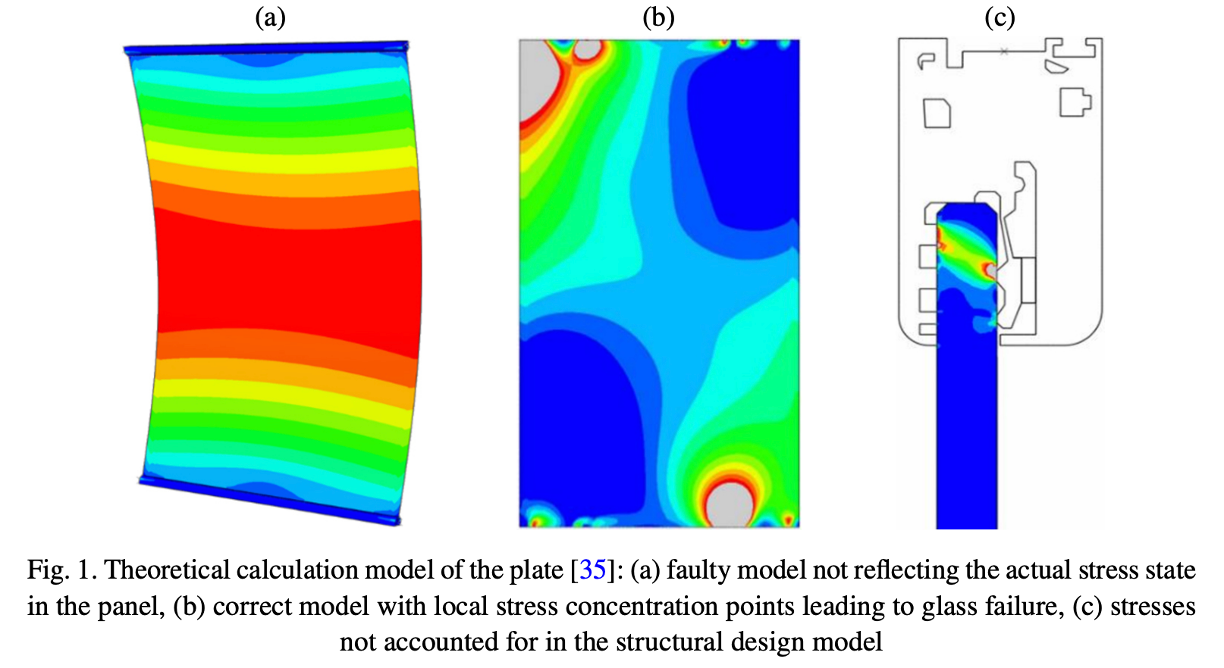
These often stem from incorrect structural assumptions, such as:
One documented example involved a curtain wall where insufficient spacing between glass and metal transoms caused direct contact under wind pressure, leading to local cracking and full panel failure.
On-site problems — like improper installation of gaskets or tolerances — directly affect façade lifespan. A notable case involved a glass fin façade where floor finishes were built flush against the fin edges.
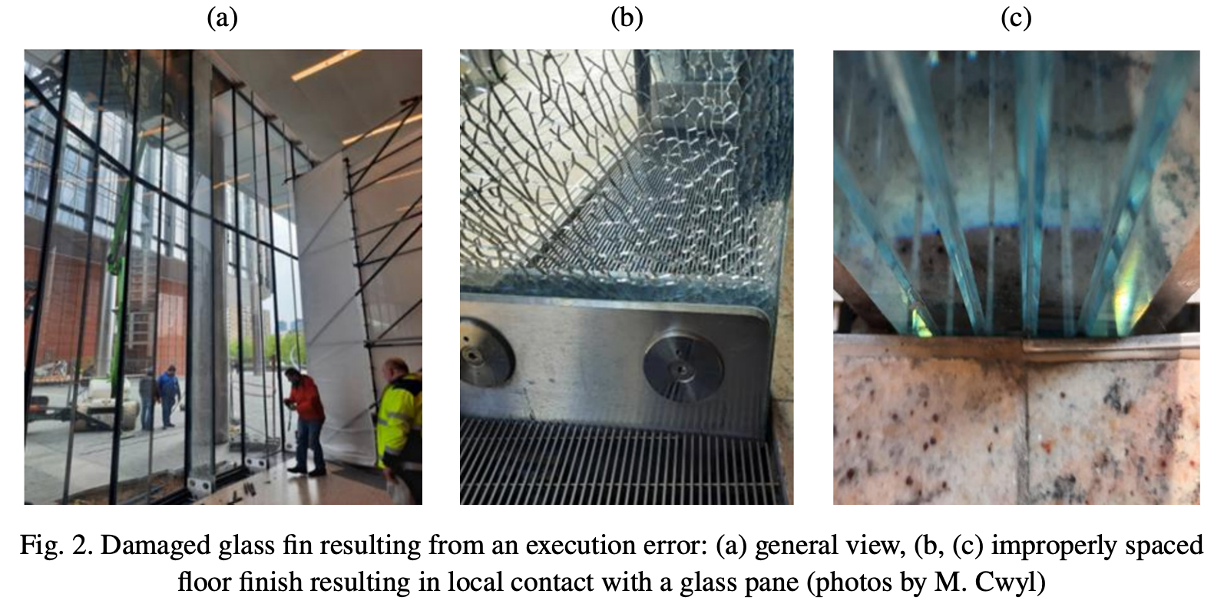
Thermal expansion caused localized stress and eventual fracture of an entire fin element.
Glass façades have an average lifespan of 25 years, requiring periodic replacement of gaskets, sealants, and brackets. Poor maintenance can transform minor deterioration into catastrophic failure.
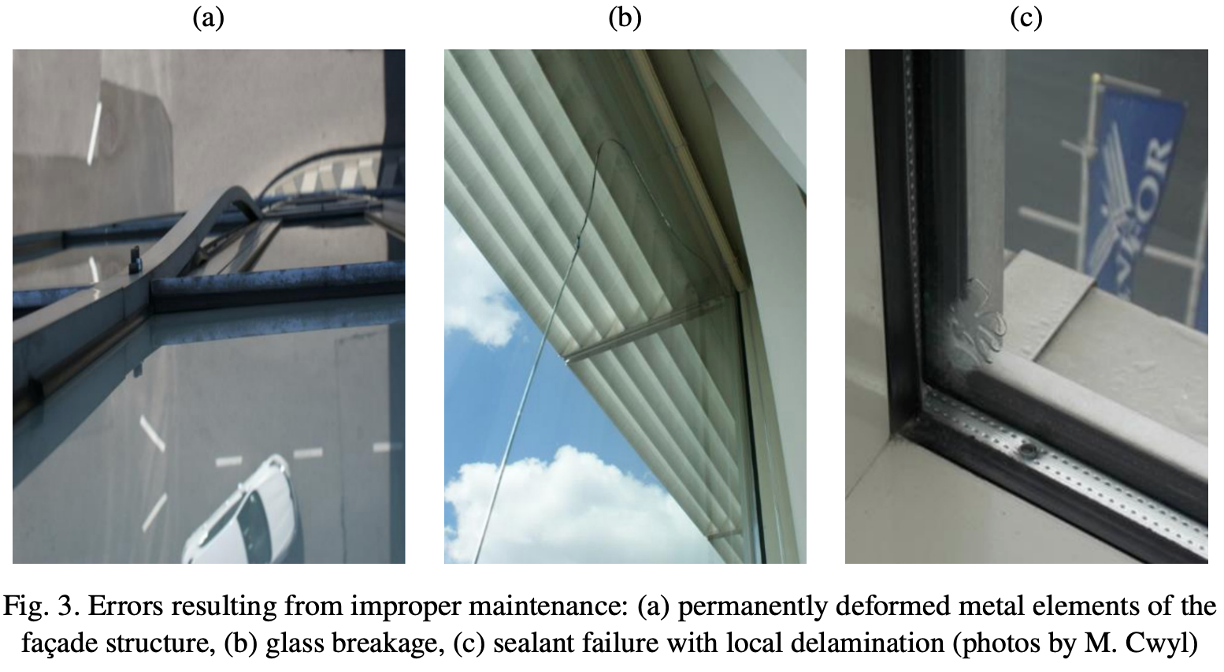
In one observed instance, technicians fixed loosened aluminum trims using screws that prevented thermal movement, leading to deformation and glass breakage.
Such “quick fixes” reveal a persistent lack of understanding of façade dynamics in long-term use.
The study distinguishes among the three dominant façade typologies
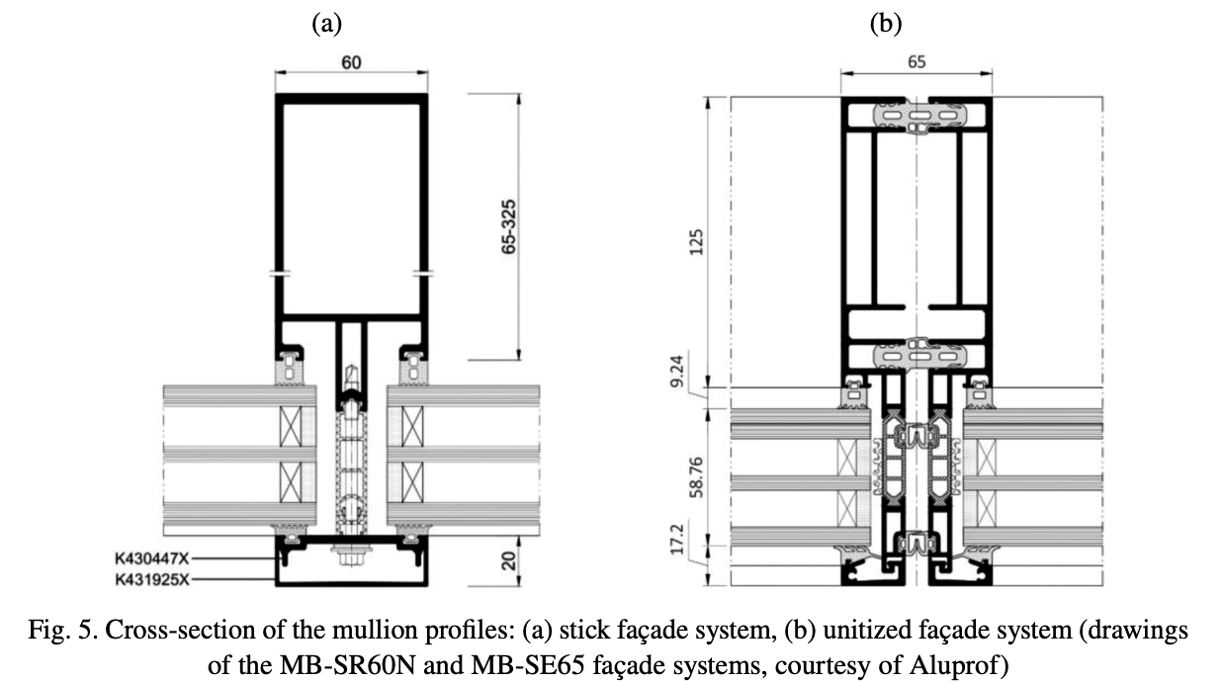
Each typology defines how loads are transferred and how thermal movements are accommodated. In multi-storey projects, unitised façades offer superior precision and speed, while point-fixed glass systems push the boundaries of visibility — turning the façade into a nearly invisible membrane.
For façades exceeding eight meters in height, glass becomes part of a hybrid structure — supported by trusses, cables, or even glass itself.
Perhaps the most iconic example is the Markthalin Rotterdam (MVRDV, 2014), where 35×42 m façades are suspended using an orthogonal cable-net system.
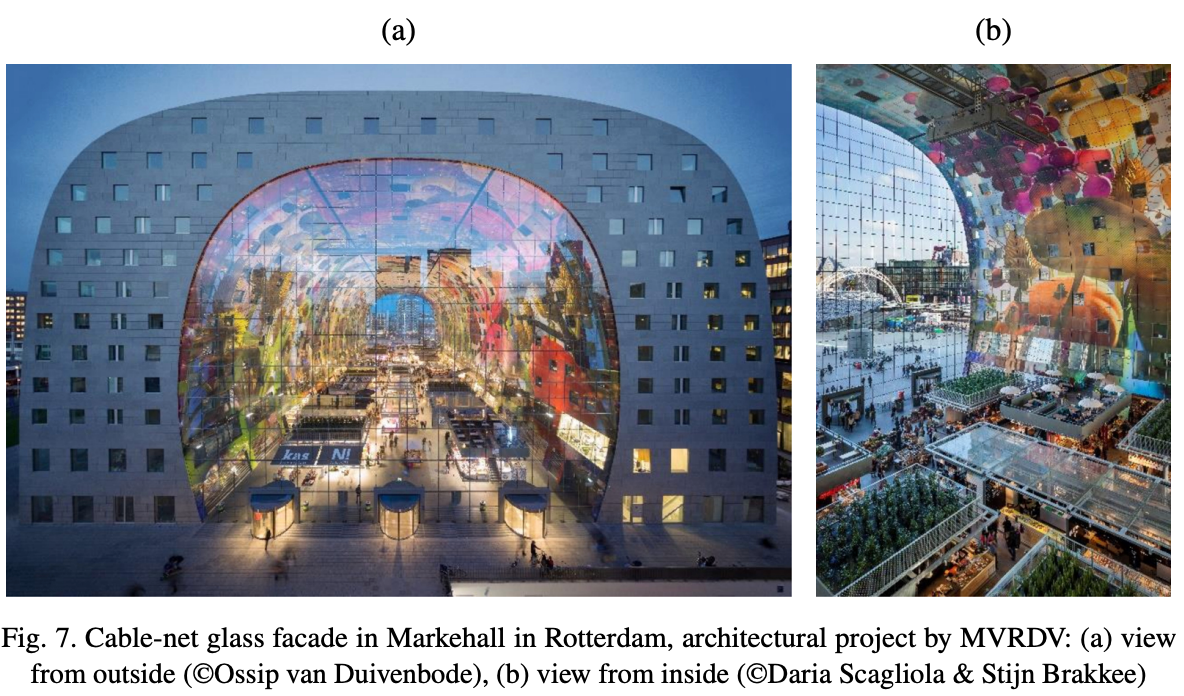
Each laminated glass panel, 6 mm + 6 mm with a PVB interlayer, is connected by stainless-steel fittings, forming a transparent curtain that gently flexes under load.
This innovation exemplifies how transparency and tension can co-exist,redefining the envelope as both a structure and a spectacle.
Another step in structural minimalism is the use of glass fins — vertical laminated beams that carry wind loads.
In 320 South Canal, Chicago (Goettsch Partners, 2022), fins over 12 m tall, made of four 12 mm heat-strengthened plies with SentryGlas® interlayers, allow the lobby façade to reach full double-height transparency.
Here, glass supports glass — a conceptual and technological breakthrough in load transfer.
In projects such as the Sub-Center Library in Beijing (Snøhetta, 2022), façade design reaches monumental scale: 15.8 mhigh insulating glass units weighing over 11 tons each. These zigzag-shaped panels, 133 mm thick, combine five outer plies with two inner tempered layers and a 20 mm cavity, sealed with structural silicone.
The geometry itself — faceted, not curved — provides the stiffness needed to resist wind loads while preserving visual clarity
Modern façades are not just transparent barriers; they are environmental interfaces that regulate energy flow, light, and comfort.
The authors examine the performance evolution from single-skin to double-skin and closed-cavity façade (CCF) systems.
Studies show that CCFs outperform even triple-glazed units in thermal control and user comfort, representing the future of climate-responsive envelopes.
One of the most significant outcomes ofKozłowski, Cwyl, and Jóźwik’s study is its connection to the upcoming Eurocode10: Design of Glass Structures (prEN 19100).
This long-awaited standard will, for the first time, integrate glass into the European structural design framework — formalizing calculation methods for in-plane and out-of-plane loading, fracture mechanics, and post-breakage behavior.
In parallel, conferences such as GlassPerformance Days (Tampere), Challenging Glass (Delft), and the Facade Tectonics World Congress continue to drive interdisciplinary dialogue between material science, architecture, and engineering.
As Eurocode 10 nears publication, the façade industry moves closer to a unified methodology — one capable of aligning safety, efficiency, and creative freedom.
Failures in glass façades are rarely due to one factor alone.
They are cumulative — the result of small compromises across design, fabrication, and maintenance. What the research underscores is the interdependence of the entire façade ecosystem: architects, engineers, manufacturers, and operators must share responsibility for long-term performance.
The examples of cracked fins, misplaced fixings, and unanticipated stresses are reminders that façade engineering is not a linear process but a continuous dialogue between precision and unpredictability.
Beyond mechanical performance, the next challenge is sustainability and reuse. Glass, though infinitely recyclable, remains difficult to disassemble due to coatings, sealants, and embedded materials.
Yet new initiatives — from thin triple glazing to low-carbon interlayers such as Trosifol® R3 — show that the industry is moving toward lighter, more repairable, and environmentally conscious systems.
In the coming decades, the façades that define our cities will not just reflect the environment — they will actively participate in its regeneration.
The research by Kozłowski, Cwyl, and Jóźwik reminds us that transparency demands rigor. Glass façades embody the paradox of modern architecture: technically fragile yet symbolically strong; minimalist inform yet maximalist in complexity.
By combining structural understanding with innovation in materials and design standards, glass is entering a new era — one where façades are not merely designed to perform, but to endure, adapt, and evolve.
Full Paper:
Structural Aspects of Using Glass in Façades – Archives of CivilEngineering, 2025






























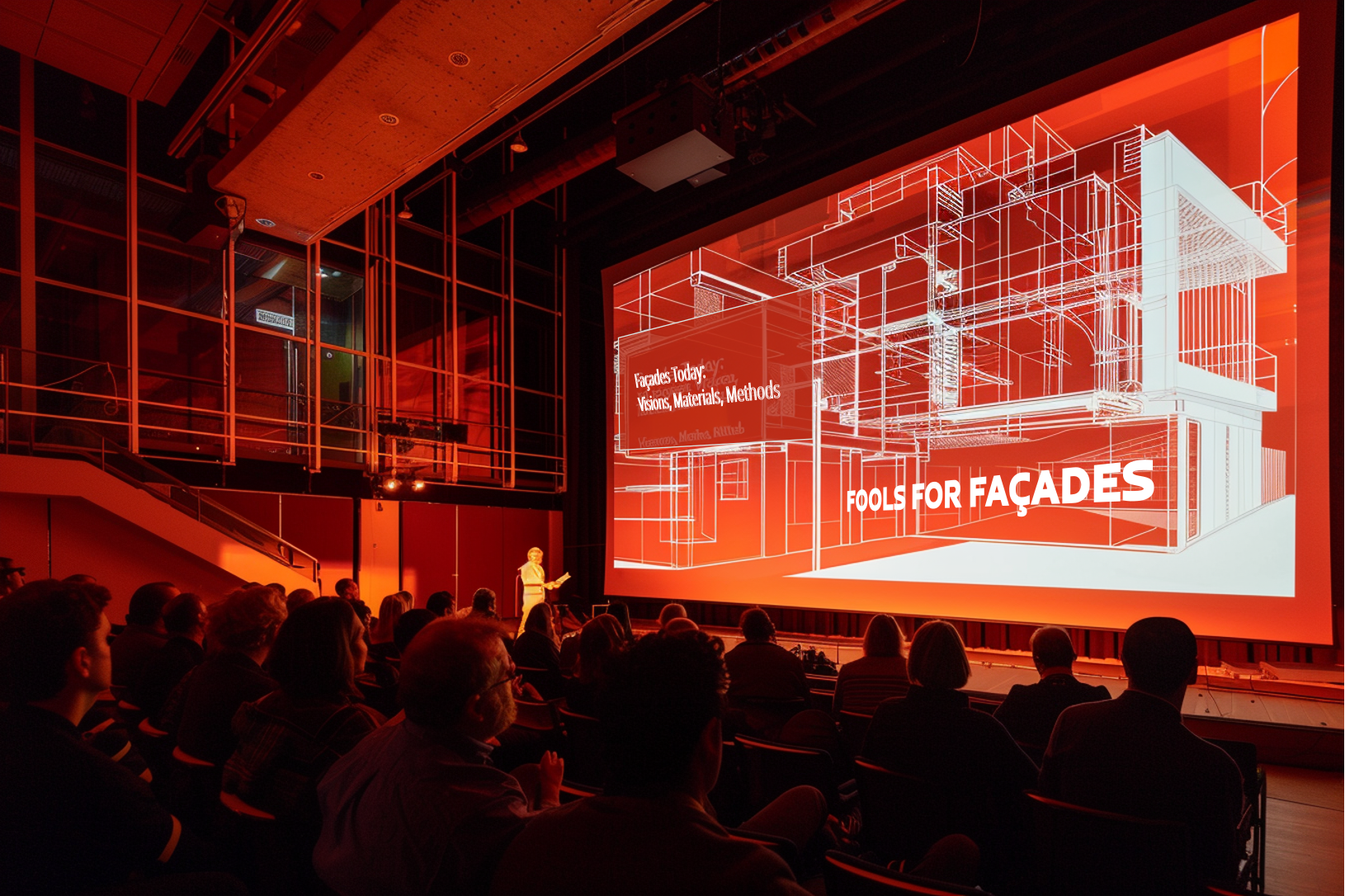
"Facades Today": is a one-day conference exploring contemporary approaches to façade design, innovation, and cultural meaning.
Expect critical insights, surprising case studies, and practical visions for what comes next in urban envelopes.

Location:
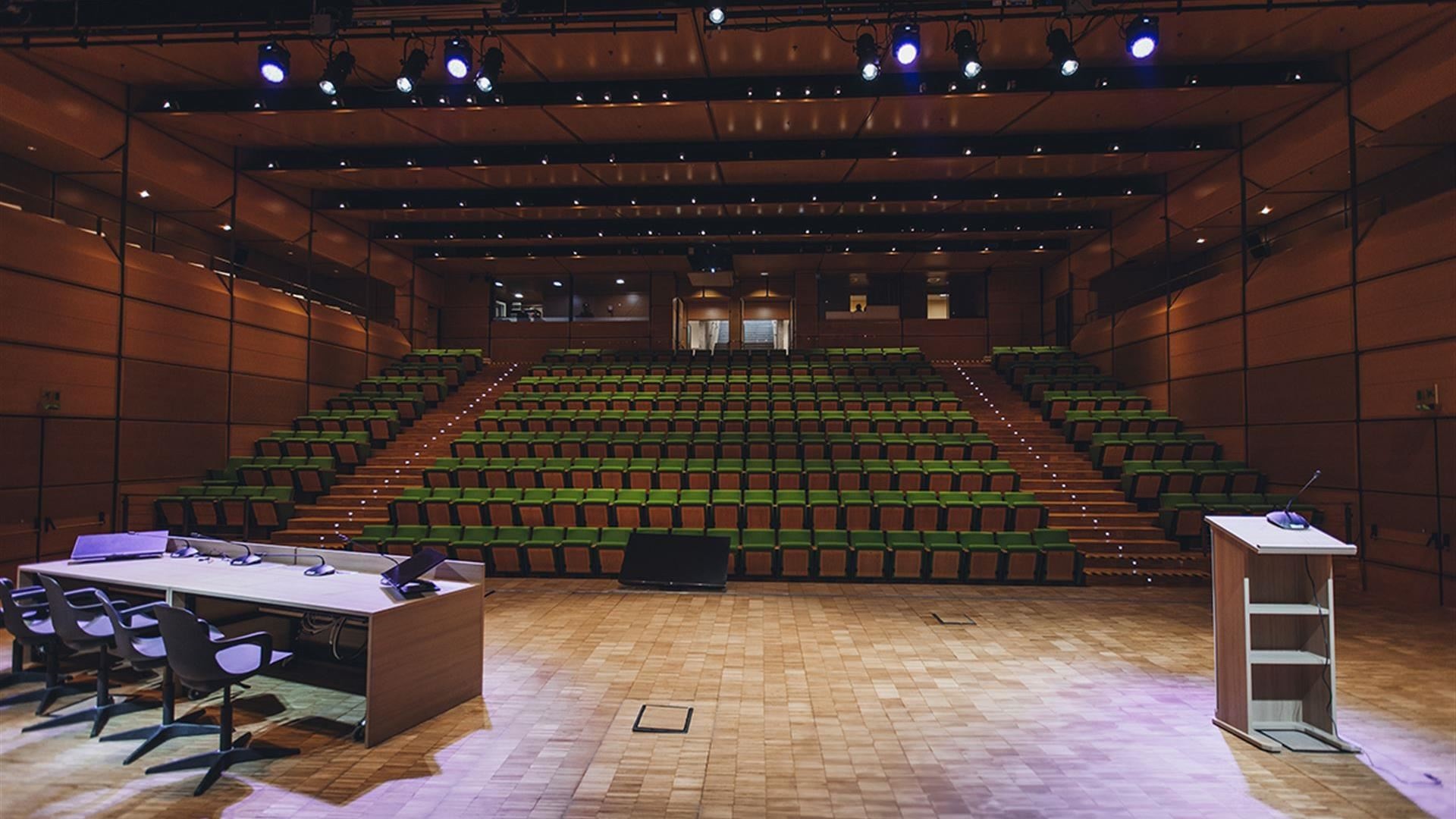
Milan, Monte Rosa 91 - Auditorium

Date:
April 24, 2026 — 09:00 to 18:00

Audience:
The people who shape buildings—designers, engineers & makers

Contact: events@foolsforfacades.com
Join the archive that celebrates architecture’s most iconic façades.
If your company played a role—through materials, systems, or expertise—let us know.
We’re building a record of the people and products behind the world’s most influential buildings.
Are you working on façade innovation, materials, or design methods?
Submit your study and be part of the conversation shaping tomorrow’s architecture.


.png)
.png)
.png)