
0


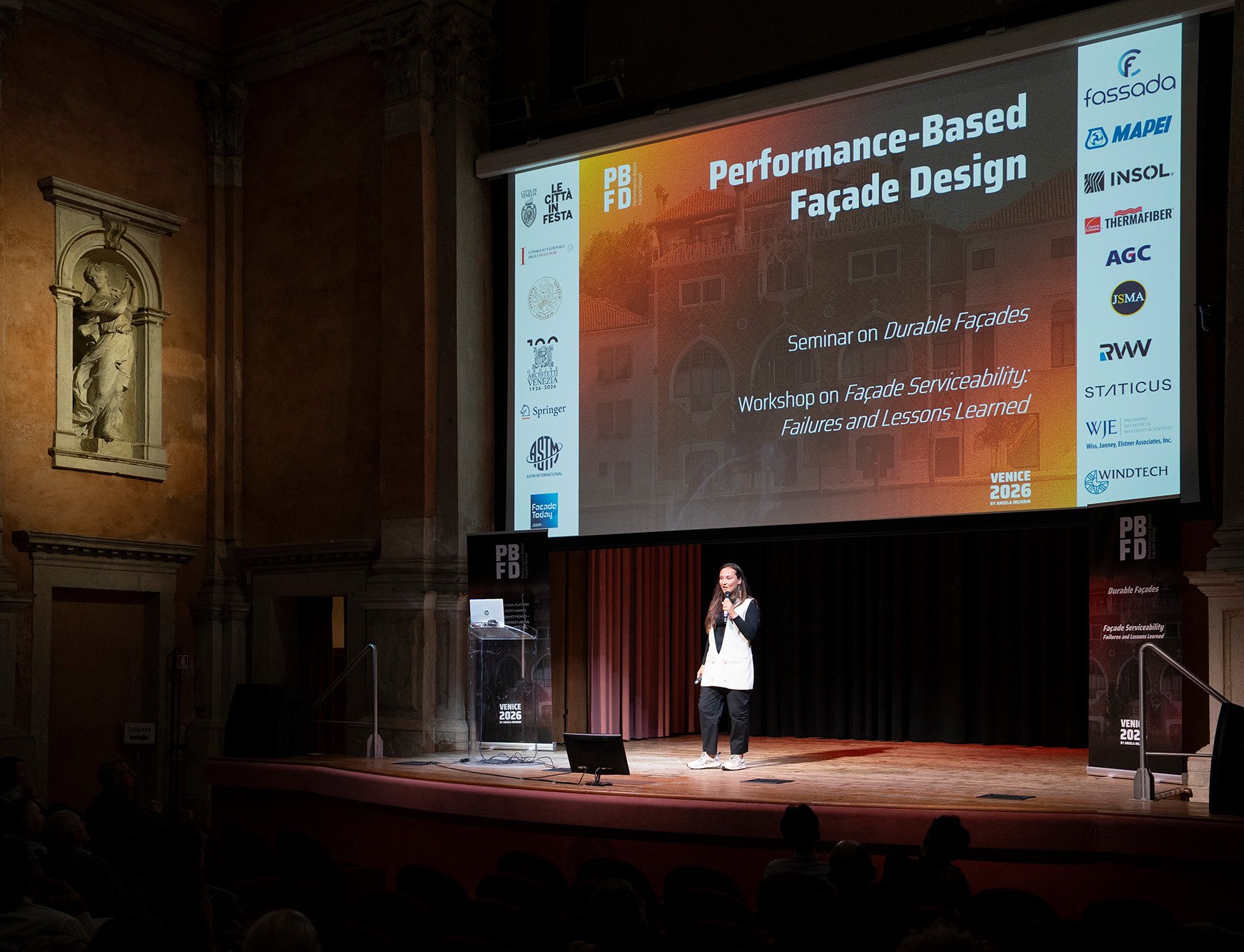
Angela Mejorin is a façade consultant and researcher based in Venice, and the founder and curator of Performance-Based Façade Design (PBFD). She started on site, on the Permasteelisa envelope of Renzo Piano’s Intesa Sanpaolo tower in Turin, before two doctorates at Iuav and Western University, research on cyclone-resistant façades for the CTBUH and the leadership of ISO 16316:2024. After the fourth edition of PBFD, she talks to the FFF Journal about durability, serviceability, wind, standards, and why the most sustainable façade is very often the one already installed.
Your work focuses on performance-based façade design. How would you explain this approach to someone who still sees the façade mainly as a technical specification or architectural skin?
A specification is the end of a conversation. Performance-Based Façade Design (PBFD) is the beginning of one. In a prescriptive framework, a façade is compliant when it matches a description: this glass make-up, this U-value, this test pressure. In a performance-based design framework, you first define what the envelope has to do in a precise building location, for a certain type of occupancy, for a determined lifespan, under specific circumstances, and then you demonstrate that it does it, against acceptance criteria you have consciously chosen.
The difference is not rigour since prescriptive rules are perfectly rigorous. The difference is who owns the question. Calling the building envelope a skin should start to sound like the living mechanism it is: it is simultaneously a structural element, an environmental filter, an acoustic barrier, a fire compartment boundary, a water management system, and a building system we routinely prototype and test at full scale before we build it. Once you accept that it has to perform against a hazard set specific to that site and that orientation, you stop asking whether it complies and start asking: against what, and for how long, with what type of behavior. Everything I do, from the consulting side to the standards work and the PBFD conference, comes out of that second question.
In your view, what does a truly high-performing building envelope need to address today beyond energy efficiency?
Energy efficiency is now the easiest part of the brief on paper, because it is measurable at handover and rewarded by certification. Almost everything harder happens afterwards, also related to energy performance over time.
Durability first: the service life the envelope actually achieves, as opposed to the one assumed in the carbon calculation. An envelope replaced at twenty-five years instead of fifty has quietly doubled its embodied impact, whatever its operational figures said on day one. The same sentence can be written in capital terms, and for an owner that version is more persuasive: the façade is somewhere between a fifth and a quarter of construction cost on a commercial building, so an unplanned recladding at year twenty-five is not a maintenance item. It is a second façade purchase inside a single holding period, plus the rent forgone while it happens, on an asset whose valuation was underwritten on the first one lasting. Then hygrothermal behavior under a climate that no longer matches the reference year the design was checked against. Condensation risk, moisture accumulation in assemblies, and the biological consequences of both arise rapidly after the project is delivered. It is no longer acceptable to witness rapid declines of façade performance in the first years of a building's life, especially considering that the envelope is the only passive system we have to govern the operational carbon footprint of our building stock.
Then serviceability, which is where most façades actually disappoint their owners: water at moderate wind combined with rain, noise, operable vents that bind, movement that was accommodated on paper but not in the built tolerance. Then maintainability, meaning access, replaceability and the honest question of whether a component can be changed without scaffolding the building. And finally information: whether anyone in year thirty still knows what was installed, and to what specification.
That last point is seriously underrated, and we are glad that in Europe the introduction of the Digital Product Passport for construction products will start to address this lack of information, pushing for the long-term vision about maintenance and circularity. It is one of the reasons durability is the theme of PBFD 2026 rather than a session within it.
Wind-related performance is one of your key areas of expertise. What are the most underestimated wind effects on modern façade systems?
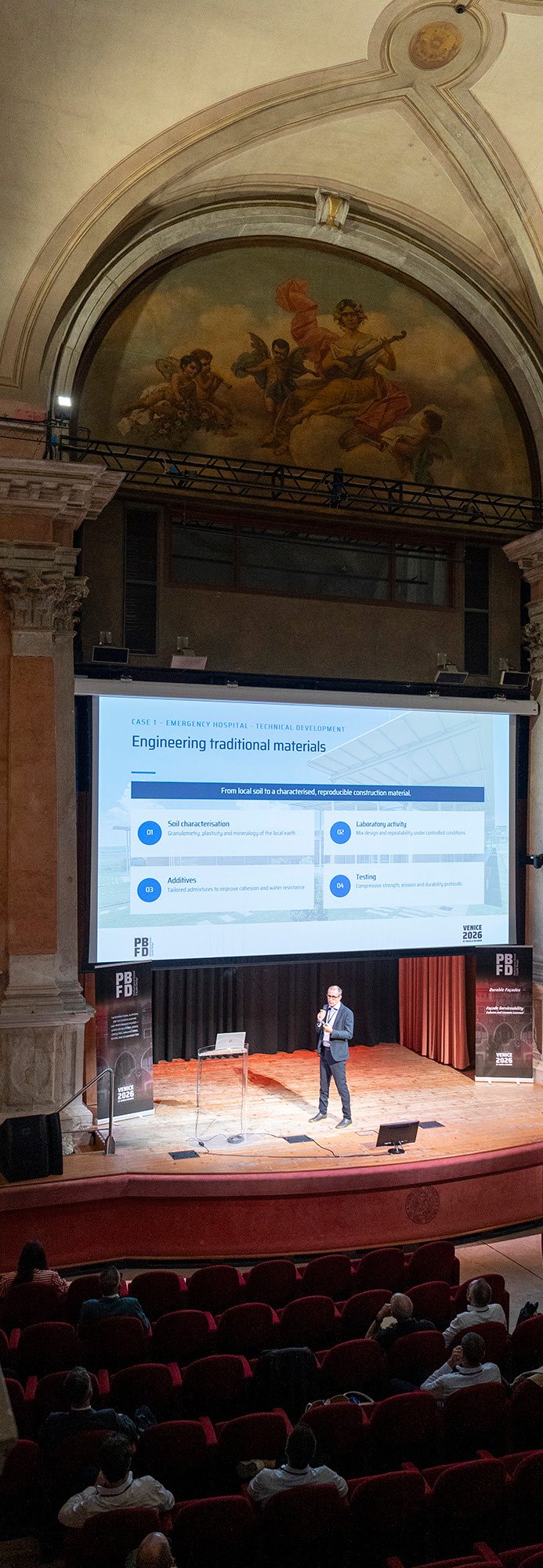
The extreme event is rarely the problem for the structural components of a building that are up to date, but it can still be tricky for building envelopes because the loads specified for façades in international design frameworks are not derived with the same safety coefficients used for the primary structure. This is a consideration I would highlight for the extreme wind events, such as typhoons and tropical cyclones, that I have been focusing on for a few years, developing an alternative design framework for wind-borne debris impact resistance of façades that is now enclosed as an Annex in the ISO standard that focuses on this curtain wall performance. Most of the economic losses in extreme wind events are related to wind-borne debris impacts on façades, resulting in breakage of the building envelope, tears in the laminated interlayer, water penetration, mould in the interior, and so on. These effects often lead to radical consequences such as the demolition of the entire building, even when its structure is still sound. That is what happened to the iconic Capital One Tower in Lake Charles, Louisiana. Hurricane Laura took out its glazing in August 2020 and the structure was never the problem, but the seventy-three tenants left, the owner put the cost of bringing the tower back up to code at 167 million dollars, the insurer disputed it, and after four years of vacancy and litigation a twenty-two-storey building was imploded in September 2024 against a seven-million-dollar demolition fund. A functioning asset was written off through its envelope. Outcomes of this kind are avoidable, given the building science available to us today, and they are the clearest answer I have for anyone who still treats façade performance as a design question rather than a capital one.
Besides wind-borne debris impact, the most underestimated effects related to wind are now the ordinary ones. Cyclic loading is first. A façade sees millions of wind pressure reversals over its life at a fraction of the design load, and gaskets, sealants, fixings and hardware degrade under that repetition in ways a single static test never reveals. These are not catastrophe losses. They are attritional ones, spread thinly across a portfolio and rarely attributed to the envelope at all, because nothing dramatic happened on the day. Second, serviceability-level wind: the moderate, frequent conditions under which water ingress, whistling and vibration occur, and which no current standard adequately addresses. That gap is precisely why I am leading an ASTM work item on full-scale wind tunnel testing of building envelope systems at serviceability level. Insol addressed exactly this problem at PBFD 2026, drawing on full-scale testing at its own facility in Invercargill, New Zealand.
As buildings become taller, lighter and more complex, how should façade design respond to issues such as movement, deflection, vibration and serviceability?
I am extremely passionate about façades and tall buildings and I believe façade design needs to treat serviceability as a design limit state with explicit criteria, not as the residue left over after strength has been verified. This is something I have been discussing during my presentations in the last years, especially considering façades very rarely fail structurally. They fail by moving more than the joint could accommodate, by leaking at an interface, by binding, by cracking a sealant that was detailed for half the displacement it received, by losing the gas from the IGUs.
The technical response is to account for the full movement budget rather than one component of it: thermal, structural live load, creep and shrinkage of the concrete structure, inter-storey drift, construction tolerance and installation sequence, accumulated across the real stack-up rather than the idealised one. The organisational response matters just as much, because most of that budget is consumed by decisions taken outside the façade package. A well-documented example was presented at PBFD 2026 by the SGH team: a fifty-storey hotel where improper shoring produced slab deflections that racked window frames and caused top-hinged operable vents to fail. Nothing in that chain was a façade design error in the conventional sense. Every consequence was a façade consequence.
Where do you see the biggest gap today between façade design intent, testing standards and real long-term performance?
The performance mock-up is the clearest illustration. It is a spotless sample, built by the best available crew, with fresh sealant, on a rig that does not fully reproduce the restraint conditions of the building, tested at a single instant in time, against loads applied one at a time. The real façade is built by rotating crews over a few months, ages for five or six decades, and experiences those loads simultaneously and repeatedly.
We are very good at qualification at day zero and very weak at everything after it. There are few accepted protocols for accelerated ageing of assemblies rather than materials, almost none for combined and sequential loading, and no systematic feedback loop carrying forensic findings back into the standards that were supposed to prevent them. Failures are investigated, settled, and, because of confidentiality, largely lost to the discipline. The organisations holding the most complete record of how façades fail are the insurers who paid for it, and they are almost entirely absent from the rooms where test methods are written.
That is the largest data asymmetry in our field, and it is a solvable one.
Closing that loop is the entire premise of the second day of PBFD 2026, the workshop on Façade Serviceability: Failures and Lessons Learned, co-chaired by Daniel J. Lemieux of WJE, who chairs ASTM Committee E06 on Performance of Buildings. It is run in partnership with ASTM International so that what is discussed at the workshop has a route into a Selected Technical Paper publication and, eventually, into standards work.
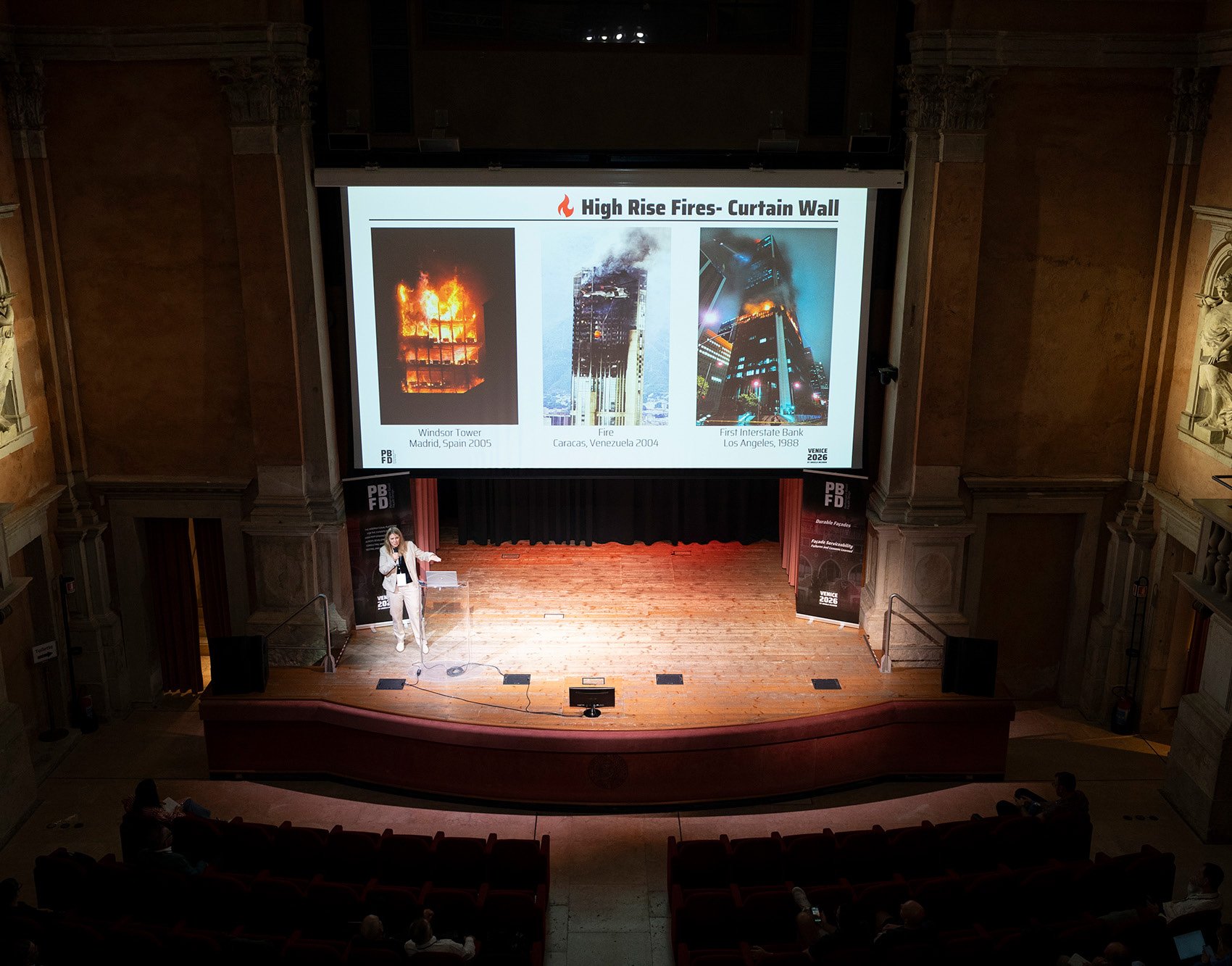
Climate risk is increasingly shaping the built environment. How should façade engineers rethink resilience in relation to extreme wind events, storms and changing environmental loads?
We should start by being honest that our design wind speeds rest on an assumption of stationarity: that the statistical properties of the historical record describe the future. That assumption is weakening, and not uniformly: it fails differently for synoptic winds, for convective events, for hail, for wind-driven rain and for heat waves. It is not just about wind: recorded temperatures and flood events point the same way, and it is there for everyone to see. The practical consequence is not simply higher numbers. It is a shift from load-based to consequence-based thinking. What happens to the building if the envelope is breached? How quickly can it be made watertight, airtight and insulated again? Is the failure mode graceful, or does one broken unit pressurise the interior and cascade? Can damaged components be sourced and replaced in weeks rather than years? Post-event functionality and repairability are resilience properties, and they are almost never specified. They are also what decides the size of a business interruption claim, which on a commercial building can run well past the physical damage, and they are increasingly what underwriters want to see before they price a tower in an exposed market. How an envelope fails, how quickly it can be closed and whether the components to close it still exist are façade engineering questions with insurance consequences, and very few people are currently able to answer them on both sides. Specifying them costs very little at design stage. Discovering you did not is what costs money.
I would add that compound events deserve far more attention than they receive. Wind arrives with rain; heat arrives with drought and thermal cycling; storms arrive with debris and, increasingly in some regions, with hail. We test these one at a time because that is what our apparatus allows, and then we are surprised by interactions. I don’t want to sound negative. We are experiencing the most interesting revolution of recent decades with the implementation of machine learning and AI tools in every business sector. This turn is already pushing for better control of our building skins, integrating sensors and collecting data that can be used to build better buildings soon. Even a demolished building can be used as a benchmark for improving design solutions. We are therefore at a stage that is full of opportunities, and I am confident that sooner than expected we will see innovative solutions or frameworks that can change our industry. And I am so confident because that conversation already happened, with exactly those guests and partners, at PBFD 2026, and will continue at PBFD 2027, from 22 to 24 September.
You previously worked on global research around cyclone-resistant façades. What lessons from that field are becoming relevant for a wider range of buildings and regions?
The research I carried out for the Council on Vertical Urbanism (formerly CTBUH) compared practice in Australia, Hong Kong, Japan and the Philippines, and the most durable lesson was that debris, not pressure, drives the failure sequence. A small, fast projectile perforates the envelope, the interior pressurises, and the resulting internal loads finish what the impact started. Once you see that mechanism, you see it elsewhere. It is worth stating in those terms because it is the shape of a vulnerability function: a small, cheap breach at a predictable weak point, followed by a loss orders of magnitude larger. Whoever prices that risk is pricing the first event and paying for the second.
That is why it now travels. Mid-latitude regions that never considered impact are dealing with hail, with thunderstorm downbursts, and with tornadoes. I spent almost three years on wind engineering research within the Northern Tornadoes Project at Western University, in a country that does not think of itself as a debris environment. Wildfire ember attack follows a comparable logic: small airborne particles against a brittle, sealed skin, where the vulnerability is at joints and openings.
The second transferable lesson is regional. Cyclone-prone markets such as Australia and the hurricane-prone states of the US solved these problems decades ago, through impact-rated glazing, shutter systems, hardware selection, post-event inspection regimes. Other markets are meeting these issues for the first time. That asymmetry is one of the reasons I keep the PBFD audience deliberately international. A problem that is urgent in one geography frequently has a mature answer in another, and the only way to find it is to put those people in the same room. My Ph.D. research also fed into the development of ISO 16316:2024 on wind-borne debris impact testing for windows, doors and curtain walling, which I led as Project Leader, and which was drafted with contributions from the first PBFD workshop in 2023, organized in partnership with ISO.

How can performance-based design help architects and engineers move beyond prescriptive solutions and develop façades that are more adaptive to specific project risks?
A prescriptive framework can only approve what it already describes. That is not a defect, it is the definition, but the consequence is that anything genuinely new is non-compliant by construction, before anyone has asked whether it is safe. A geometry no test standard anticipated, a new interlayer, a shading system with no classification to be tested against: the project either drops it to stay inside the safe zone, or carries it as an unqualified risk that nobody in the contractual chain wants to own. Architects, engineers and manufacturers are not short of ideas. They are short of a legitimate route to approval, and that is what performance-based design gives them.
The performance-based route inverts that. You establish the hazard and exposure for the specific site, agree the consequence class and the objectives, define acceptance criteria and the evidence needed to satisfy them, and then design a test and analysis programme to produce that evidence. The result is a façade calibrated to its actual risks rather than to the average of a code population, which usually means effort is spent where the exposure is and not spent where it isn’t. It also leaves a defensible file behind the decision, which matters when a building control body, an insurer or, years later, an expert witness asks why this system was accepted. That is most of what I am called in to do: projects where the exposure is unusual, or where a system has no standard to be tested against and one has to be written for it.
What actually moves the industry, though, is economic. Adaptability is an active field of research, but a research paper does not change a specification and a number in a business case does. That number comes from insurance, from a system whose performance can be demonstrated to hold rather than assumed to hold, and from the moments in a façade’s life when planned intervention costs a fraction of replacement. So a performance-based approach has to address performance over time as explicitly as it addresses day one, identifying in advance the points at which a façade needs work to keep it up to standard.
You are active in ISO, CEN and ASTM committees. How important are international standards in shaping the future of façade engineering?
Standards are where research becomes procurement language. A performance requirement that cannot be specified, tested and verified in a contract does not exist in practice, however good the science behind it. That translation step is what committee work does, and it is chronically undervalued because it is slow, unglamorous and largely invisible from outside.
They matter especially in this industry because our supply chains are genuinely global. A building is designed in one country, engineered in a second, fabricated in a third and installed in a fourth. Standards are the shared vocabulary that makes that possible without renegotiating first principles on every project. They also function as institutional memory: a test method encodes a failure that someone, somewhere, paid for. Where no failure has yet occurred for a given performance, the corresponding standard tends not to exist.
I spent eight years in pure research between Europe and North America, first with a focus on these two markets and then on the Asia-Pacific region and later on Oceania, and standard development has always been my way of translating academic research into something useful for our business sector. There is no innovation without a project, and turning frameworks into procedures that apply to thousands of projects worldwide is what I find most rewarding.
I got in touch this week with an Indian representative I worked with when involved in the CTBUH project and he shared with me the progress made in recent months in their building code towards more resilient building skins in cyclone-prone areas, especially for wind-borne debris resistance. The research report I first authored is used there as a reference document, and I am proud of this kind of outcome.
Serving as Project Leader and Voting Member across ISO, CEN and ASTM has also taught me a great deal on a personal level. Patience is definitely not my first quality and consensus is slow by design. The right response is to feed the process better and earlier evidence, which is a large part of why PBFD exists in the form it does.
Do you think current façade standards are evolving fast enough to respond to climate change, new materials and increasingly complex building envelopes?
Not uniformly, no. A new standard takes several years from work item to publication, and revision cycles run over several years, depending on the standardization body. Digital tools, material innovation and the climate signal itself all move considerably faster than that.
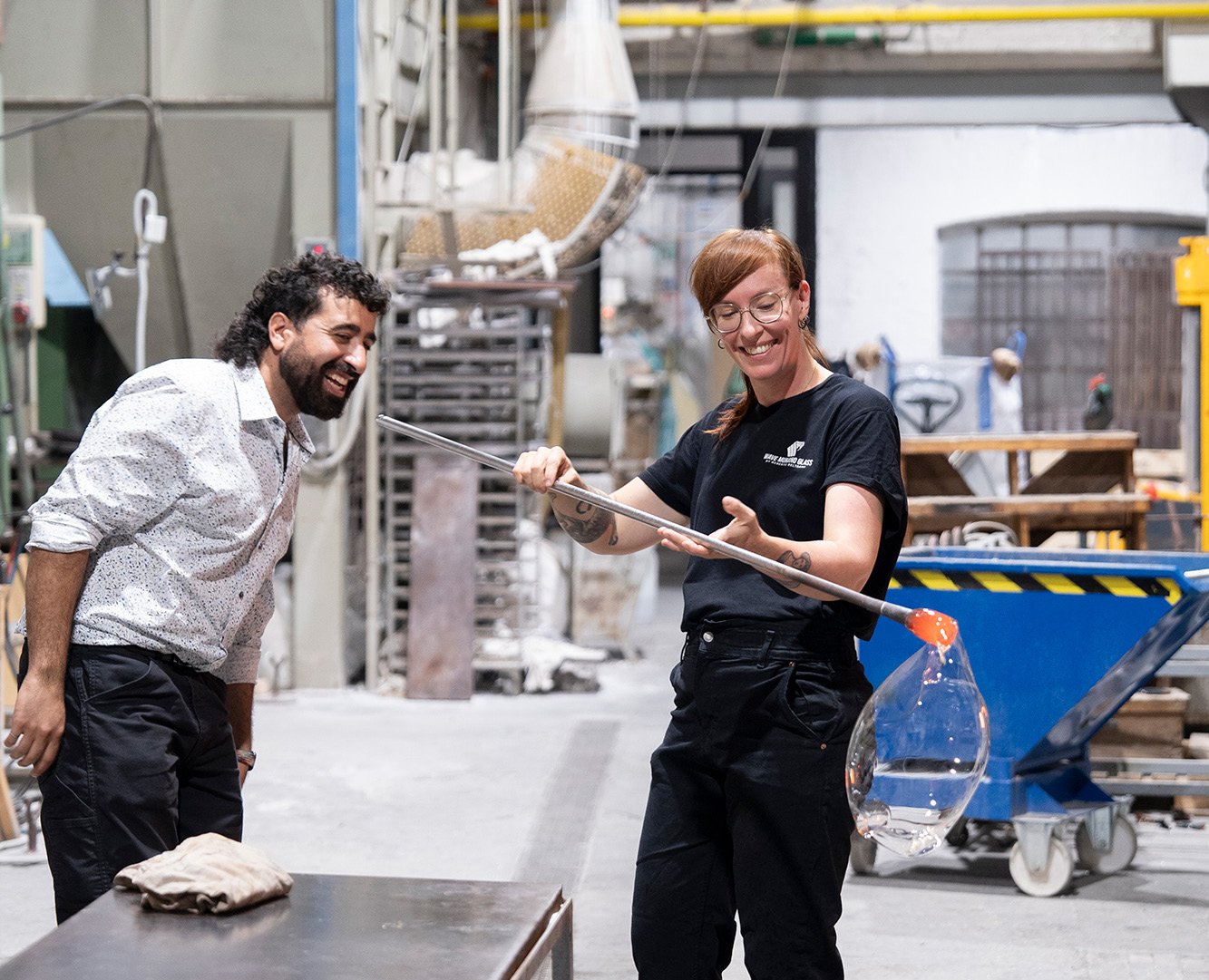
I would resist the conclusion that consensus should simply be accelerated, though. The value of a standard is that it holds, and standards written quickly tend to be standards revised in embarrassment. Committees are starved of the two things that would let them move faster: forensic data from real failures, which is locked behind non-disclosure agreements, and full-scale test evidence, which is expensive and therefore rarely collected systematically. Where funded full-scale work does exist, it moves the discussion immediately; Daniel Haaland and Sarah Rentfro are presenting spandrel thermal testing carried out at Oak Ridge National Laboratory with Charles Pankow Foundation funding, and that is exactly the kind of evidence a committee can act on.
Practitioners who complain that standards lag are frequently not in the room where they are written.
Through PBFD, you are connecting industry, academia and standardization. Why is this dialogue so important for the future of façade innovation?
Because these three communities operate on incompatible clocks and incompatible incentives, and they very rarely meet. Industry is measured on a project deadline. Academia is measured on publication. Standardisation is measured on consensus. Each is rational within its own frame, and the collective result is that a problem can be urgent in practice, solved in a laboratory, and absent from the relevant standard, all at once.
When you put those people together, the recurring discovery is not a new idea. It is that someone already has the answer. A failure mode that is critical in the Gulf has been addressed in Japan; a testing question that stalls a European project has an ASTM method behind it. That is knowledge transfer, not innovation, and it is the fastest value the discipline can capture. Astrid Piber makes a version of this argument from the design side in her PBFD 2026 keynote, “From Icon to Intelligence”: a solution stays trapped in the building it was invented for unless the reasoning behind it is written down in a form another team can apply and argue with. A practice that wants its own work to travel ends up building a private version of what standardisation does in public, which is a stronger argument for this dialogue than anything I could say from the committee side. And in a multidisciplinary setting such as this one, many business opportunities arise because some needs are not felt within the same group and that is also the reason why every year we are expanding towards new fields: I can now announce it properly. PBFD 2027, the fifth edition, runs from 22 to 24 September in Venice, as usual, under the theme “Value in Façades: More with Less.” It grew out of the same conversations that shaped Durable Façades, and it asks the harder question that durability opens up once you take it seriously: how do we deliver façade performance, over a real service life, without simply spending more to get it.
PBFD is small for that reason, with sixty experts from three continents in 2023, a hundred in 2024, 2025 and 2026: at conference scale people watch, and at this scale they argue and discuss, interact throughout multiple days, also in curated networking opportunities. The 2027 theme, “Value in Façades: More with Less,” came directly out of arguments during the 2026 edition. The Advisory Group, which includes voices such as Mikkel K. Kragh (Arup), Agnes Koltay (Koltay Façades), Frank Maas (EDGE Technologies), Michele Pasca di Magliano (ZHA), Vivian Manasc (Reimagine), Daniel J. Lemieux (WJE), Stefano Rossi (WSP), Akira Kudo (JSMA), and Lorenzo Pandolfi (Logic Planning), exists to keep that selection honest rather than convenient.
What was the original ambition behind founding Performance-Based Façade Design, and how has the initiative evolved since then?
The original ambition, in 2023 at Università Iuav di Venezia, was narrow and quite specific: to open up a standardisation process. I was leading the drafting of what became ISO 16316:2024, and it seemed absurd that a document with real consequences for façade safety was being written by a small committee without the practitioners it would govern in the room. So the first edition paired a seminar on the current challenges of performance-based design with a workshop that fed directly into the drafting.
What has changed is scope, not premise. In 2024, at the Scuola Grande dei Carmini, Façade Reflections added AI-driven design optimisation and circularity, and a sold-out seminar of a hundred. In 2025, Technology Meets Nature filled the Auditorium Santa Margherita with keynotes from ZHA, Koltay Façades and Werner Sobek, and a debate that produced the 2026 theme.
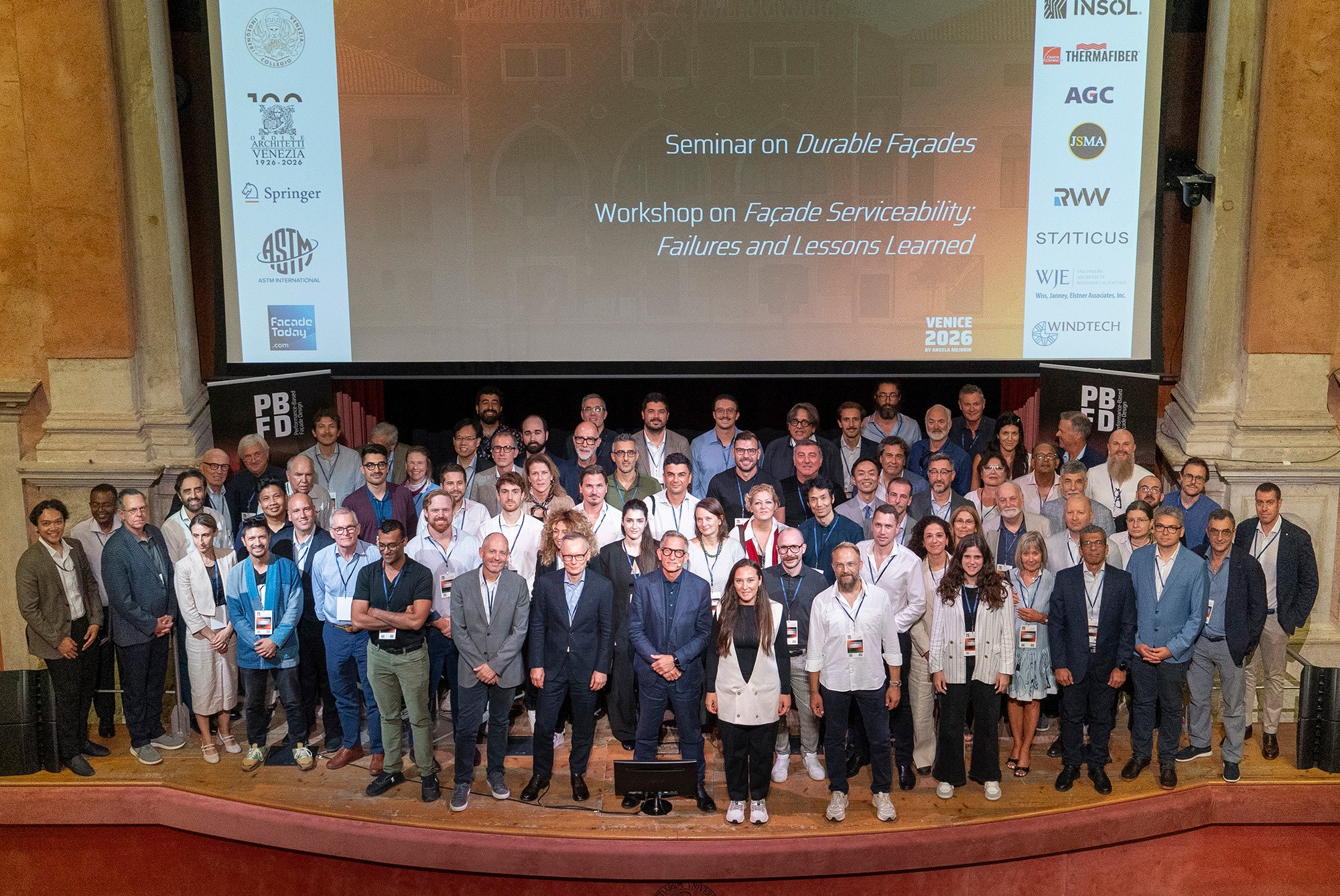
The 2026 edition, held from 16 to 18 September, was the fourth, and it was the first where the whole pipeline was visible: a seminar on Durable Façades, a workshop run with ASTM International, two book partnerships, CPD and CFP accreditation, and the patronage of the City of Venice. It brought together six keynote speakers — Silvia Prandelli (Populous), Balázs Bognár (Kengo Kuma & Associates), Astrid Piber (UNStudio), Francesca Vagliani (Covivio), Andrei Koshelev (ETH Zurich) and Massimo Colomban, founder of Permasteelisa. It exceeded what I had planned for it — not in numbers, but in the quality of the discussion, the engagement of the room, and a willingness to share knowledge openly that I had not seen at this intensity before. More than once this year I watched professionals who are direct competitors spend real, relaxed time together, past the usual networking formalities.
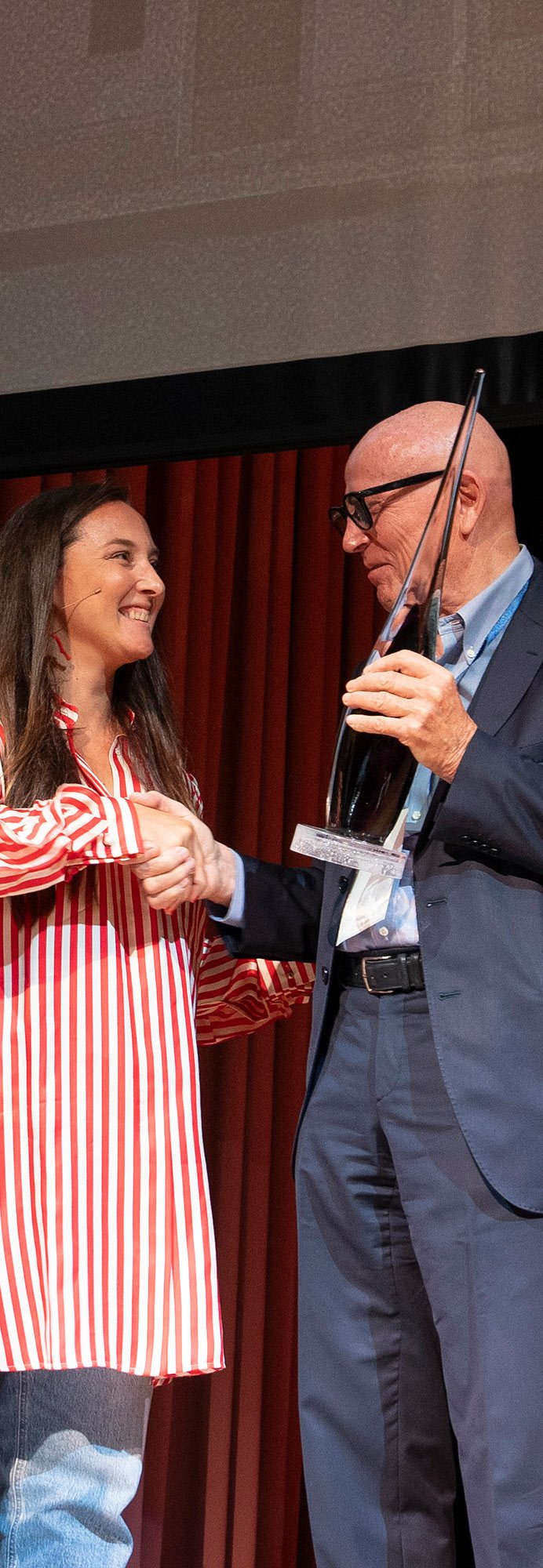
The moment I will carry with me from 2026 is the PBFD Career Recognition, awarded to Massimo Colomban. He had stepped back from this world for a few years, and seeing him visibly moved, back in the room, being recognised by the community he helped build, meant more to me than almost anything else in the four editions so far. PBFD has become a platform with a publication route, rather than an annual event.
With the first PBFD book published by Springer and the PBFD 2026 Workshop organized in editorial partnership with ASTM International, what topics do you believe deserve more attention from the façade community?
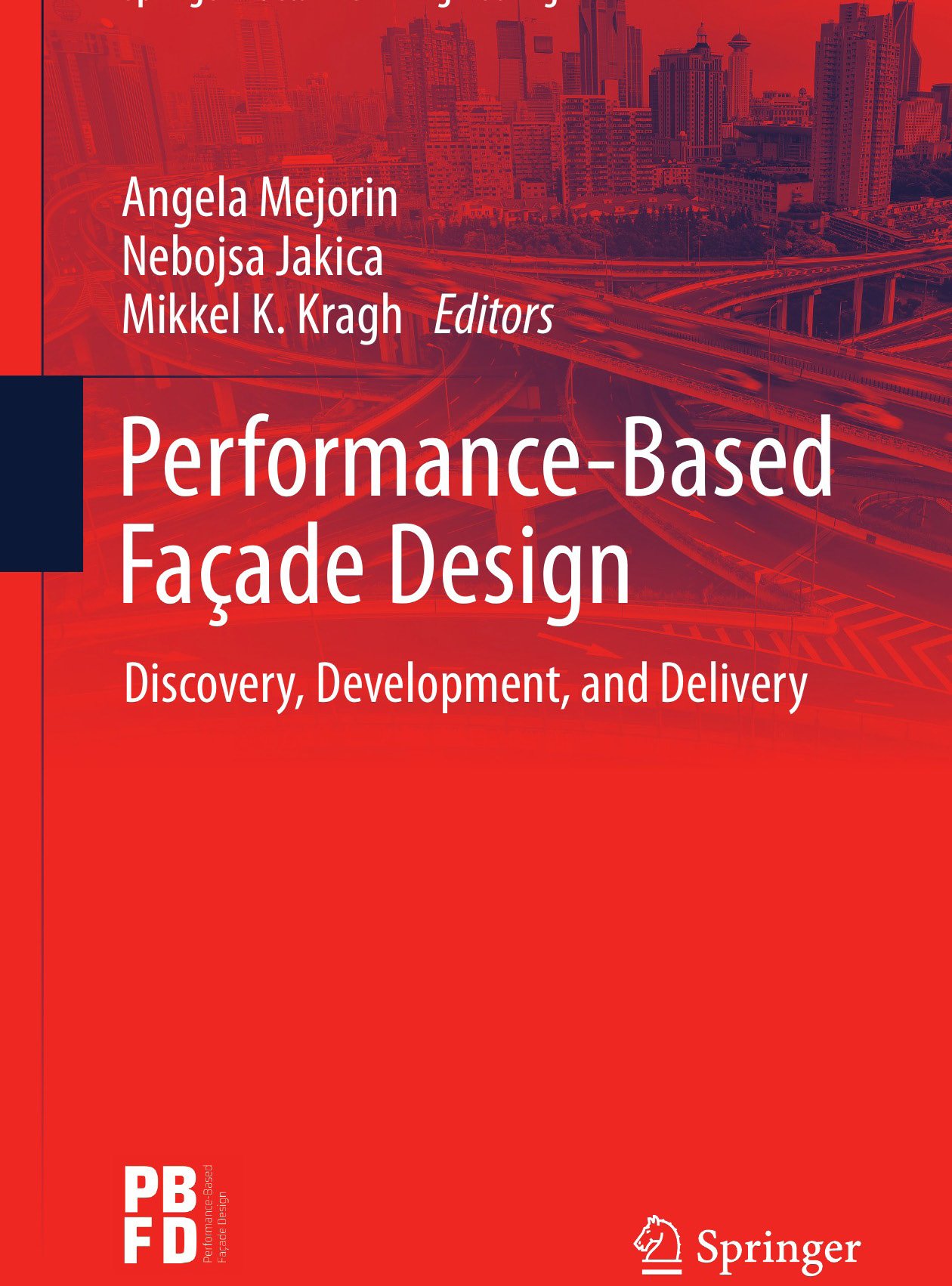
At PBFD and with the PBFD publications we aim to promote technical excellence and to provide tools and strategies to push the envelope. The first volume, Performance-Based Façade Design: Discovery, Development, and Delivery, is published by Springer Nature and was launched at PBFD 2026 on 17 September, edited with Mikkel K. Kragh and Nebojsa Jakica. The response since launch has been the most gratifying part of this whole year, and copies are available now on SpringerLink. It is articulated in three sections: latest research tools and frameworks to establish façade performance; new building enclosure systems that have been implemented and tested (ready to go); recent and ongoing international projects that have addressed specific challenges and moved the discipline to new frontiers. The second book by Springer, PBFD: Durability, is now in preparation, collecting the talks and chapters from the incredible PBFD 2026 edition, and is on track for publication in 2027. Deciding what goes into those volumes forces the question you are asking.
The editorial partnership with ASTM International is for a Selected Technical Paper publication linked to the PBFD Workshop on Façade Serviceability: Failures and Lessons Learned. The workshop speakers are producing technical papers that will be collected in a book to be published in 2027.
Coming to the urgent topics we aim to address in the near future, the first is service life prediction: we use "durable" as an adjective when it needs to be a number with a stated confidence and a stated exposure. That is not a philosophical preference. A number with a confidence interval can be underwritten, warranted and financed. An adjective cannot. Second, the existing stock, meaning the twentieth-century envelopes now reaching the end of a service life nobody planned, where the interesting engineering is repair and rehabilitation rather than replacement. Third, information continuity: how the knowledge of what was built survives the handover.
Underneath all these topics sits the same unresolved question: who is responsible for envelope performance across sixty years, when every organisation involved in delivering it has moved on within five? Do we have companies and businesses that are comfortable leasing a building enclosure to a developer? The commercial logic is not exotic: if the party supplying the envelope also carries its performance for thirty years, the incentive to specify against first cost disappears on both sides of the table, and the service life stops being an assumption in a spreadsheet and becomes a contractual number. This precise question is going to be answered in Venice this year by one of the speakers and I am curious to see the reactions in the room. I don’t want to say more at this stage.
I am incredibly grateful for the first PBFD book launch in 2026, and for the thought that at PBFD 2027 we will be able to leaf through three peer-reviewed scientific volumes produced by this niche network that is growing over time: the two books published by Springer and the one by ASTM International.
You have worked across research, consulting, standards and international knowledge platforms. How has this interdisciplinary path shaped your way of looking at façades?
Each of those roles asks a different question about the same object. Research asks why something behaves as it does, and tolerates not knowing. Consulting asks whether it works on this project, by Friday, within this budget, and does not tolerate not knowing. Standards work asks whether we can all agree on how to measure it, which is a slower and more political question than either. Curating PBFD asks who else has already faced this, which turns out to be the most efficient question. Teaching asks the fifth, and it is the most exposing of them: whether any of this can be explained to someone who was not there when it was learned. I have taught a module on performance-oriented façade design at the Bauhaus-Universität Weimar summer school for the past two years, after years of studio teaching at Iuav and Western, and this summer I worked with ZHA on their Venice studio. The keynote invitations are the same test in public: an Australasian wind engineering workshop in New Zealand, a glass manufacturing conference in Toronto, a climate summit in Munich, among other ones. Various audiences with almost nothing in common except that each of them owns a piece of the same problem, and none of them will accept the vocabulary of the other two.
My own path ran through the construction side first: my first project was the Intesa Sanpaolo headquarters in Turin, a half-billion-euro Renzo Piano tower where I worked for the general contractor on the installation of the Permasteelisa envelope. Five façade types on one building: an active double skin on the east and west elevations, with a unitised inner leaf and motorised glass louvres hung in front of it; 1,600 square metres of integrated photovoltaics on the south; the insulating glass units; the bioclimatic greenhouse at the top; and the podium systems at street level. Each detailed to the standard an RPBW project demands, and all of them arriving on site in a sequence somebody had to make work. Then the Alfa Romeo Museum and other projects in the Milan fashion district and Porta Nuova, before two years of research between Iuav and the CTBUH and then two doctorates, at Iuav and at Western University. Having built before researching matters more than I expected. It is the reason I distrust results that only hold for a specimen assembled under laboratory conditions, and the reason I take tolerance, sequence and workmanship as engineering variables.
Practically, it means I read a façade as a set of open questions with different owners, and my work is mostly making sure each question has one.
Looking ahead, what do you think will define the next generation of resilient and sustainable façades?
I have been very inspired by one of the books I read this summer: “The Total Designer: Authorship in the Architecture of the Postdigital Age” by Lluís Ortega. It describes perfectly our current stage, in which we have many specialisations and different kinds of expertise. The author does not focus on façades; the façade specialist is simply one of the experts brought to the table. But what he says applies to our business sector too, since it is the most sophisticated and interdisciplinary part of the construction industry, and one in which many consultants work together on the same project. I see and wish for the next generation of façades to push further on the interdisciplinary approach, since it has proved to work in the past. Some of the game-changing advances came from applying to enclosures technologies developed in other sectors, such as the nautical industry or aerospace engineering. I am thinking, for example, of curved glass and yacht design, and of digital tools developed for aerospace engineering, such as CATIA, and their adaptation to building purposes. I am currently working on a new ASTM standard inspired by aeronautical engineering, to assess porous façade serviceability in full-scale wind tunnel tests and their behavior when exposed to cyclic wind gusts that are representative of the design wind speed.
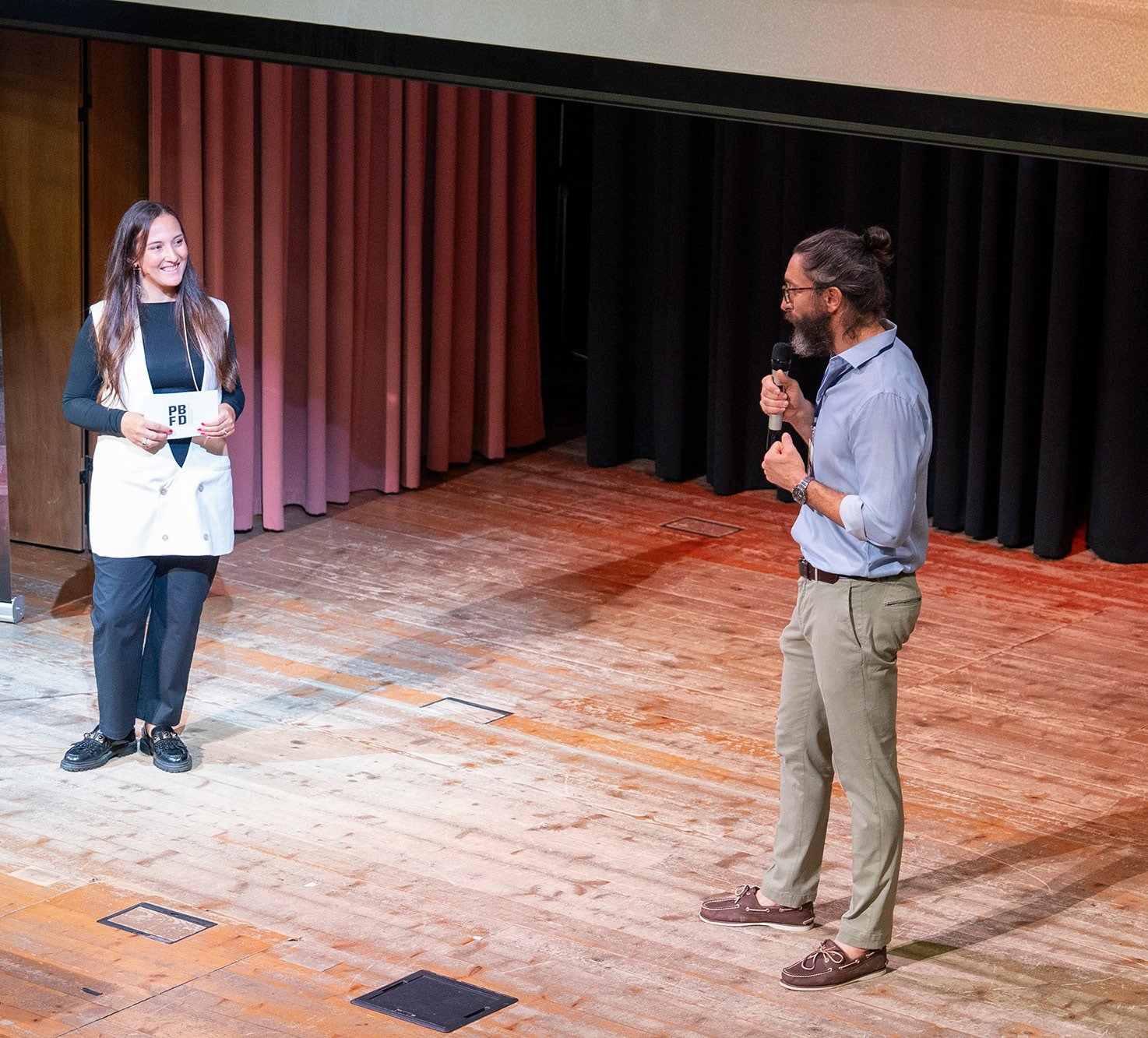
I like to think of the next generation of façades as living systems, as living skins in a biological sense, assessed through in-service measurement rather than a single qualification test, because we currently prove performance at the one moment the building will never be in again. Following the growing acceptance of ageing, I believe we should change our mindset and stop expecting curtain walls to look the same forever, while still expecting them to perform as planned for their whole service life, because that is where we can have a real impact in saving energy. I wish for our enclosures to find technical and formal strategies that are acceptable also from an aesthetic perspective in the same way weathering steel, whose stable oxide patina protects the material beneath, became valuable and is now treated as a premium finish. In the same way, timber elements used on cladding as shading devices should be accepted if they turn grey over time, and the same goes for other materials. I see the next generations going back to simplicity, to solutions that limit the variables of failure and encourage checks on in-service performance with easy and safe maintenance strategies, and, eventually, to a new aesthetic canon based on acceptance. The next generation of building skins should also push circular economy principles to the next level: I am not describing the recycling of materials or solutions that promote themselves as carbon negative because, in the formulation usually attributed to Lavoisier, “nothing is created, nothing is destroyed, everything is transformed”. Nothing can be put together without energy, so it is hard to imagine a genuinely carbon-negative material. Words are important, especially when in our field they are associated with technical performance. The most sustainable façade is very often the one already installed, understood properly and repaired well. It is usually also the cheaper one, and that arithmetic, a targeted repair and upgrade campaign priced against a full recladding with the rent roll kept running, is one most owners have never actually been shown. That was, in fact, exactly the conversation we had in Venice from 16 to 18 September at PBFD 2026, and the room's response confirmed how urgent it has become. We will keep having it at PBFD 2027, from 22 to 24 September, under the theme “Value in Façades: More with Less,” and I would encourage anyone working on these questions to come and argue about them in person.
The interviewee

Angela Mejorin, Ph.D., is a façade consultant and researcher based in Venice, and founder and curator of Performance-Based Façade Design (PBFD). Her work sits at the intersection of wind engineering and façade technology. She is a Project Leader and Voting Member within ISO, CEN and ASTM International, where she led the development of ISO 16316. She received the Façade Tectonics Institute Vitruvian Honors in 2023 and the ASTM International Emerging Professional Award in 2024. She is co-editor of Performance-Based Façade Design: Discovery, Development, and Delivery (Springer Nature, 2026), now available on SpringerLink. Following the acclaimed 2026 edition on Durable Façades, PBFD 2027 runs 22–24 September in Venice under the theme “Value in Façades: More with Less.”
PBFD 2027 · Value in Façades: More with Less · Venice, 22–24 September
performancebasedfacadedesign.org
Read the full issue: The FFF Journal Vol. 02
News


Other Posts



Events


Was your product part of an Urban Icon?
Join the archive that celebrates architecture’s most iconic façades. If your company played a role—through materials, systems, or expertise—let us know. We’re building a record of the people and products behind the world’s most influential buildings.

Further articles


The Newsletter
Stay close to the future of façades.
Receive curated stories, technical insights, interviews, and event updates from the global façade industry. One edition every Friday.
Oops! Something went wrong while submitting the form.
By subscribing, you agree to our Privacy Policy and consent to receive updates.

An independent editorial platform for façade innovation, material intelligence, and architectural envelope design.
Sections
Platform
Contact
© 2026 Fools for Façades. All rights reserved.


×
Get featured on FFF
Is your solution part of a project like this?
If your system, product or team played a role in a building worth talking about, tell us. Our editors read every submission and will get back to you.
Thank you! Your submission has been received!
Oops! Something went wrong while submitting the form.