
0



A deep technical insight by Chiara Bedon, Damijan Markovic, Vasilis Karlos, and Martin Larcher
In an era of increasing urban vulnerability — from accidental detonations to intentional attacks via drones or compact IEDs — building facades must be reimagined as the first line of defense.
Nowhere is this more evident than in the case of laminated glass windows, which bridge the line between openness and protection.
In their paper, “Numerical investigation of glass windows under near-field blast”, Chiara Bedon (University of Trieste), along with Damijan Markovic, Vasilis Karlos, and Martin Larcher (European Commission’s Joint Research Centre), dive into the structural dynamics of glass subjected to extreme blast loads at close range, a scenario underrepresented in current engineering standards.
This contribution goes beyond structural analysis — it pushes the boundaries of what we know about glazing, adhesives, failure progression, and safety thresholds in civilian and security architecture.
The outcome? A comprehensive simulation protocol for blast vulnerability, applicable to embassies, transport hubs, cultural institutions, and urban resilience design.
From Transparent Design to Security Risk: The Motivation
Laminated safety glass has become the go-to material for modern façades.
Offering transparency, post-breakage integrity, and improved performance under thermal and mechanical load, laminated glazing is everywhere — from airports to museums, train stations to skyscrapers.
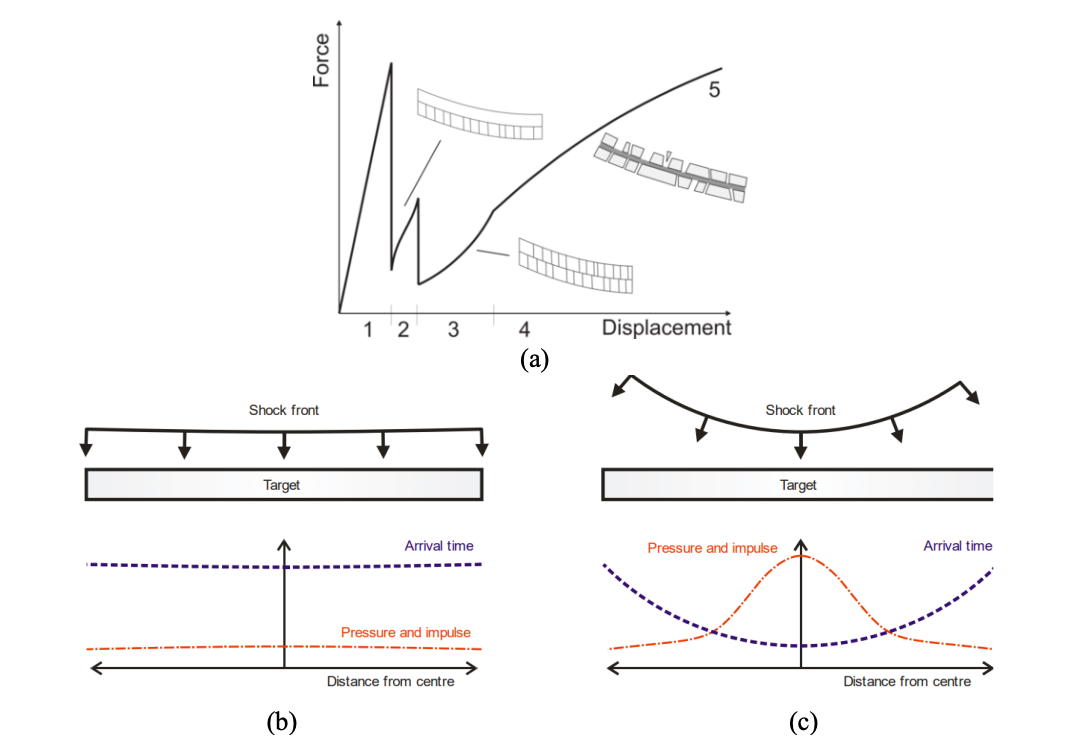
However, most façade design codes (e.g. ISO, ASTM, EN standards) and associated blast guidelines consider medium- to far-field explosions (i.e. detonation distances ≥ 10 meters). These cases generate near-uniform pressure distributions and can be modeled via simplified Single Degree of Freedom (SDOF) systems.
In contrast, near-field blasts — such as those from drones or small payloads planted on site — act within 1–5 meters from the target. Their impact is far more complex:
- Highly non-uniform pressure fields
- Short-duration, intense impulses
- Shock front curvature across the glass pane
- Nonlinear wave reflection and interaction
The engineering community lacks clear procedures or predictive tools for these cases. Enter this study — one of the first to offer validated 3D numerical models of laminated glass response under near-field conditions.
Methodology: Simulating the Unspeakable
The authors constructed three numerical models of glass windows (LGW-1, LGW-2, LGW-3) using ABAQUS/Explicit software. These models represented typical double-laminated glass panes (6 mm + 6 mm) with PVB interlayers (2.28 mm).
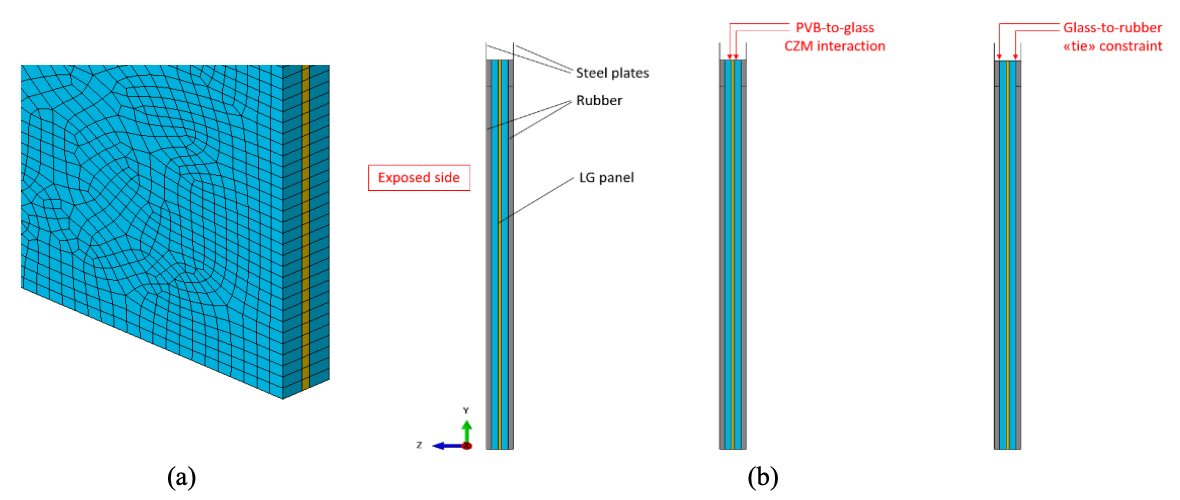
The key features of the modeling architecture:
- Brittle cracking model for glass sheets
- Allows tracking of initiation and progression of fractures
- Ductile plastic damage model for PVB interlayer
- Captures strain hardening, softening, and failure
- Cohesive zone modeling (CZM) at glass-PVB interfaces
- Simulates delamination and repeated contact after failure
- Shell and solid elements for fine control over mesh resolution
- Contact interactions with friction and pressure dependency
Loading: The Physics of the Blast
Explosions were modeled using the CONWEP blast function, derived from empirical data of TNT detonations (Kingery–Bulmash equations). Each simulation assumed the explosive mass (W) was equivalent to a TNT sphere, placed at a defined stand-off distance (R) from the center of the glass pane.
Detonation distances ranged from 0.5 m to 10 m, and reflected pressure histories were applied directly to the external glass surface — incorporating peak overpressure, impulse, and decay time constants.
Validation: From Lab to Digital Twin
Before applying the parametric study, the authors validated their model against two experimental datasets:
- Kranzer (2005): real-scale blast tests with different glass configurations
- Larcher (2012): dynamic loading with shock tube simulations
Results showed excellent agreement in:
- Time-history displacement profiles
- Crack propagation zones
- Onset of delamination and interlayer failure
- Post-damage residual integrity
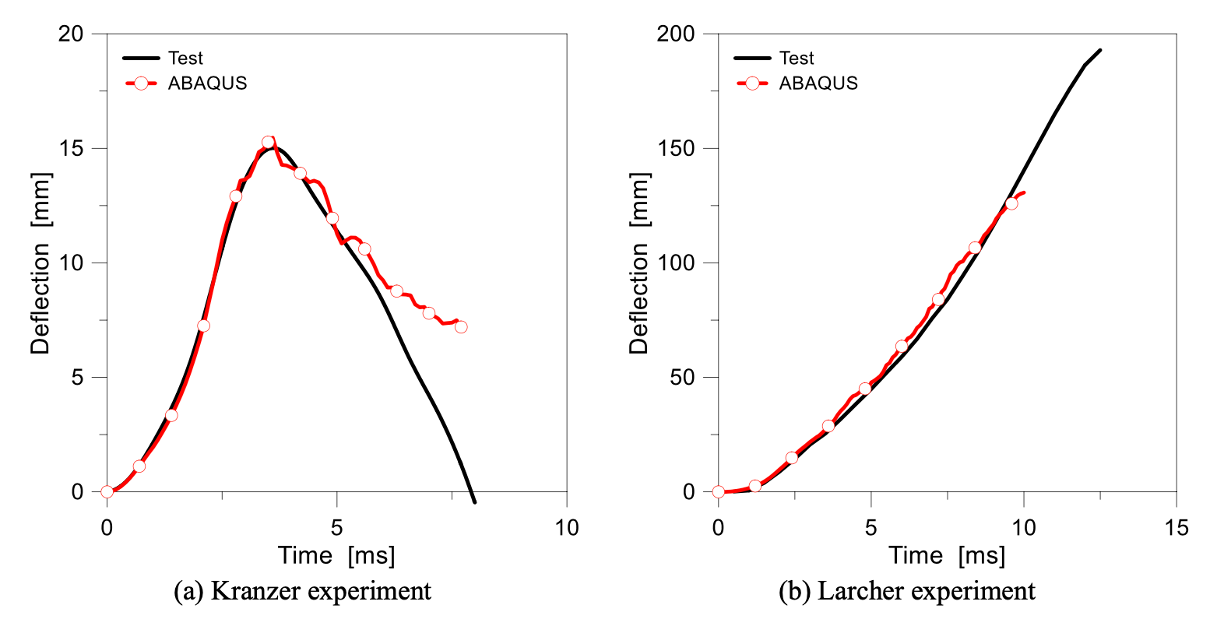
The model proved robust even in reproducing secondary fracture mechanisms like edge-induced breakage and glass spalling under reflected waves.
Results: When Glass Meets Shockwave
1. Fracture Thresholds and Damage Onset
The key objective was to identify W_min — the minimum explosive mass required to initiate significant damage for each window size and configuration. For a given pane, W_min decreased sharply with shorter R, confirming that stand-off distance is the most critical parameter in blast design.
Simulations revealed that:
- At R = 0.5 m, W_min dropped below 0.25 kg
- At R = 1 m, W_min increased to approx. 0.4–0.5 kg
- At R ≥ 3 m, response transitioned to quasi-uniform pressure modes
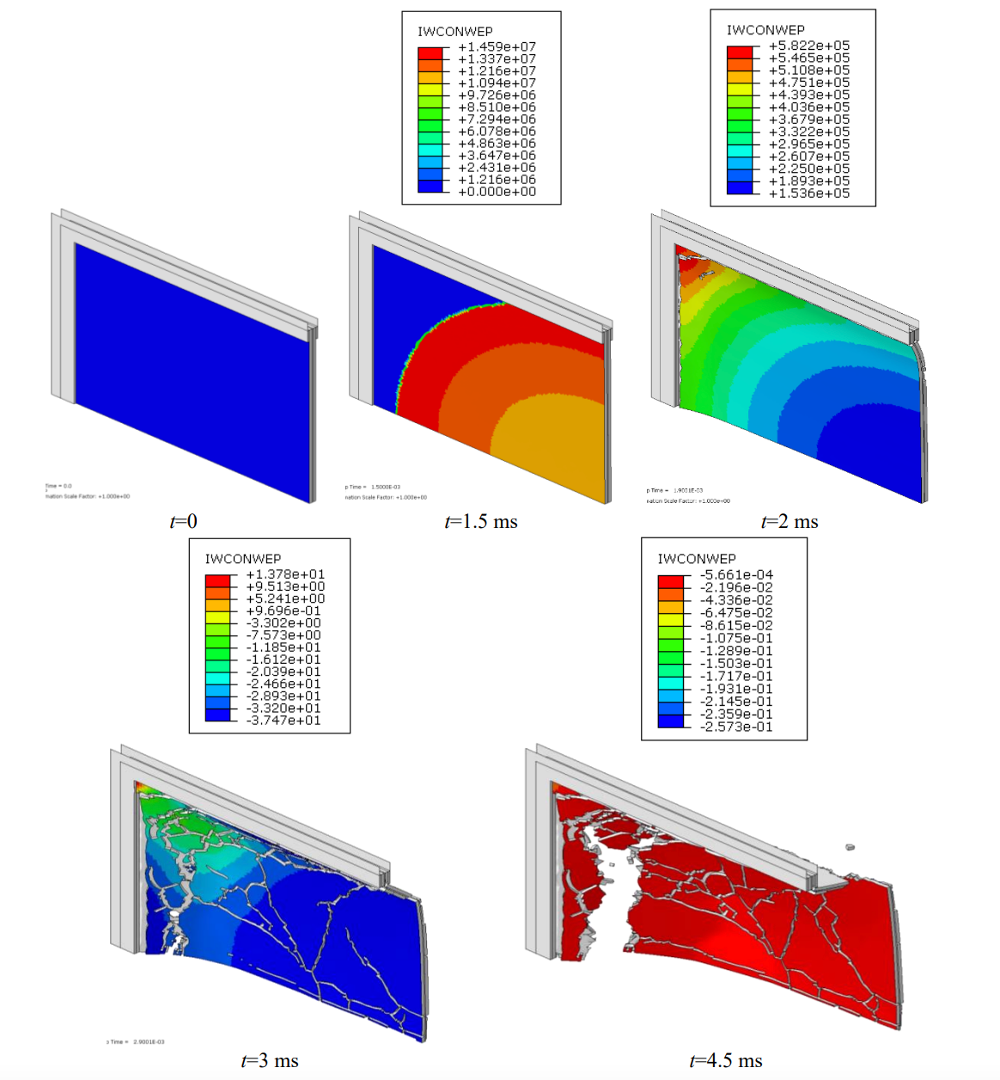
Cracks began at pane centers or corners depending on the pressure front curvature. Delamination at the glass–PVB interface followed within milliseconds, reducing composite stiffness.
2. Velocity, Acceleration, and Post-Damage Motion
Glass pane center points reached:
- Velocities of up to 4.5 m/s
- Accelerations exceeding 600 g
- Displacement amplitudes beyond 40 mm
Such movement, if not contained, could result in hazardous flying debris or complete breach. However, the PVB interlayer provided critical containment, even after full glass fracture.
3. Delamination and PVB Failure
The interlayer sustained tensile strains of up to 400%, deforming significantly while resisting rupture. Still, in extreme cases (e.g., W = 1 kg, R = 0.5 m), tearing initiated at the pane corners.
Crucially, the study showed that PVB delay failure — even under extreme strain — granting occupants valuable milliseconds to take cover or for systems to engage.
4. Failure Mode Mapping
The team proposed a failure classification system:
ZoneBlast SeverityObserved BehaviorILowElastic, no crackingIIModerateInitial cracks, no detachmentIIIHighFull fracture, intact PVBIVCriticalPVB rupture, breach of envelope
This map could help define safe envelope designs based on window geometry, glass thickness, and expected threat level.
Practical Applications: From Theory to Resilient Facades
The implications of this work are profound, especially for:
Architects and Engineers:
- Design safer façades without overdimensioning glass or adding unnecessary steel bars
- Use simulation-based testing instead of cost-intensive live blast trials
- Position and size glazing to mitigate shockwave effects via geometry
Security Consultants:
- Determine minimum safe stand-off distances (Z_fail)
- Retrofit existing buildings with optimized laminated glazing
- Simulate attack scenarios based on current threat typologies
Policy Makers:
- Reconsider blast performance guidelines in EN 13541, ASTM F1642, or GSA standards
- Push for performance-based codes rather than prescriptive thicknesses
- Encourage integration of blast modeling in standard BIM workflows
Future Work: Where the Research Leads Next
While this study offers a leap forward, it also opens doors to new research directions:
- Integration of curved or insulated glass units (IGUs)
- Modeling of glass-anchorage interactions (e.g., point-fixed or toggled facades)
- Consideration of multi-hazard scenarios (e.g., fire + blast, seismic + blast)
- Development of machine learning models trained on simulation data to predict blast performance for novel materials or layouts
Conclusion: Designing Transparency That Withstands the Unthinkable
In an increasingly urbanized and risk-aware world, façade design must balance transparency and resilience. This study from Bedon et al. offers a rigorous digital methodology to evaluate, design, and optimize laminated glass systems against near-field explosions — a critical step toward resilient, human-centered, and secure architecture.
By capturing the precise mechanics of fracture, delamination, and energy absorption in laminated glazing, this work lays the foundation for safer buildings — not just through materials, but through informed modeling, smart design, and cross-disciplinary innovation.
Download the full report HERE
Events
%201.png)

%201.png)
%201.png)
News





Was your product part of an Urban Icon?
Join the archive that celebrates architecture’s most iconic façades. If your company played a role—through materials, systems, or expertise—let us know. We’re building a record of the people and products behind the world’s most influential buildings.

Further articles

.png)
The Newsletter
Stay close to the future of façades.
Receive curated stories, technical insights, interviews, and event updates from the global façade industry. One edition every Friday.
Oops! Something went wrong while submitting the form.
By subscribing, you agree to our Privacy Policy and consent to receive updates.

An independent editorial platform for façade innovation, material intelligence, and architectural envelope design.
Sections
Platform
Contact
© 2026 Fools for Façades. All rights reserved.
.svg)
.svg)