
0


A young woman leans toward the window.
Outside, her lover looks back at her. He stands surrounded by mariachi musicians as warm rain falls steadily over his hopeful face. The musicians do everything they can to shield their wooden instruments from the downpour, though those instruments have endured harsher punishments before. He is soaked, sweating nonetheless.
Relative humidity hovers near one hundred percent, the air close to 27°C. None of that matters. His entire world is concentrated on the image framed by the window above him.
Inside, she stands in a comfortable 22°C room.
She looks down at him with affection, perhaps with the faintest trace of amused superiority. She has not yet opened the window, though she is about to. The mariachi echoes powerfully through the courtyard. She worries, briefly, that he is standing beneath a thunderstorm—that lightning could strike him—but she herself is perfectly safe.
Only then does she realize she is still wearing pajamas.

By instinct she slips on her New York Yankees sweatshirt. It makes little climatic sense: outside is warmer than inside. She wears it anyway.
She struggles to see him clearly. The room behind her is brightly lit, and the interior reflection on the glazing is winning the battle. She longs to remove the glass that stands between them. Smiling before she has even reached the latch, she closes her eyes for an instant, lifts the iron fastener, and pulls open the two timber-framed sash windows. Immediately, warm humid air embraces her face while the mariachi reaches her ears with startling clarity. Rain dampens her hair.

Inside, the surfaces of her bedroom begin to grow wet—not from rainwater, but from condensation triggered by opening the window.
It hardly matters.
At that moment, the notes of “Sabes Una Cosa”, by Rubén Fuentes, and the eyes of two lovers are all that exist. She leans against the stone balustrade that separates her from the void—and, in a way, from the embrace of the man below. Both now soaked by the rain, they simply look at one another.
§
Lieutenant Villagómez loads the final cartridge into his pistol.
Fearful, trembling, seated against a stone wall, he listens to the enemy assault. The battle is clearly being lost. His office remains dark. Only the flickering light of burning buildings enters through the window. The insurgents have the momentum. Resistance is collapsing.
Slowly, cautiously, he peeks through the left side of the window. No one appears to be watching it. A small detachment guards the insurgent commander. It is a shot he could make. He is an exceptional marksman. One bullet might eliminate the leader and throw the attacking force into confusion.
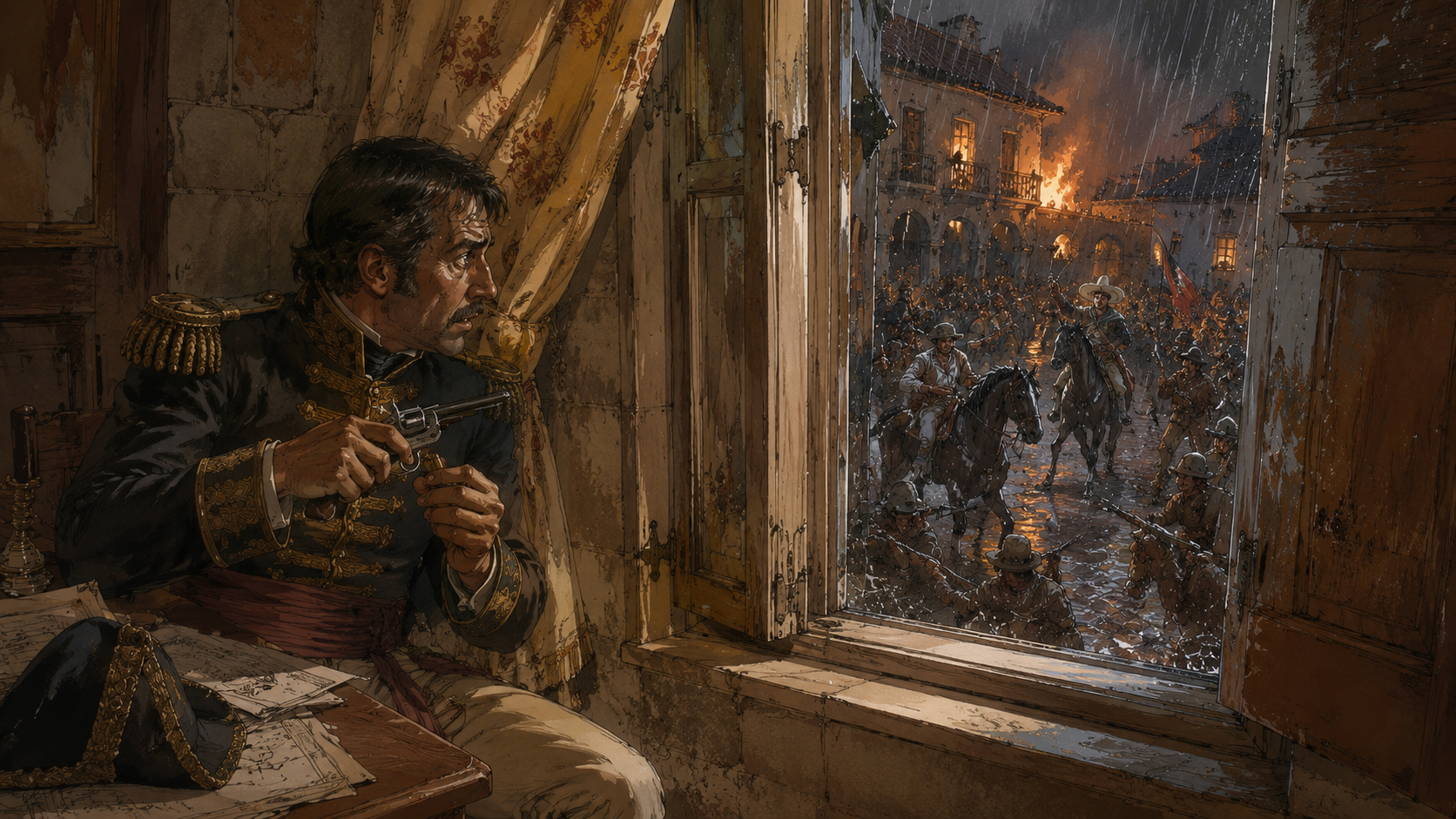
But architecture intervenes.
To fire, he must first draw back the curtains, unlatch the timber window, and throw open the heavy wooden shutters. The movement will almost certainly expose him. Night air, radiant heat from nearby fires, and driving rain will all interfere. The warm, humid air will instantly fog his spectacles. A perfect shot becomes dramatically harder.
He decides he has no alternative. He must do it. He slips behind the curtain unnoticed, quietly unlatches the window and feels, for one fleeting second, that victory is still possible. Then his glasses fog instantly as expected. He kicks the shutters open. They swing violently against the façade. The insurgents notice. Bullets begin flying in both directions.
§
Mónica walks toward Architect Suárez's office carrying a stack of A3 printed drawings. Mozart's Requiem fills the room through wireless speakers.

Mexico soccer team is playing Ecuador that evening since the world cup is happening at the moment, and the sports bar next door is already overflowing with supporters. Outside, the celebration grows louder by the minute. Inside, the architects continue working frantically. The deadline is only a few hours away.
Suárez looks up as Mónica places the drawings on his desk.
"The sky is falling," he says. "Quite a storm, isn't it?"
"Yes, Architect. I honestly don't know how they're still celebrating outside."
"Football gives people remarkable endurance."
At that very moment, the speakers sing:
Lacrimosa dies illa
Qua resurget ex favilla
Iudicandus homo reus.
§
Have you noticed? It is the very same building throughout time. In 1990, it was the bedroom of a wealthy young woman. In 1800, it served as the office of a military officer. In the 2020s, it became the studio of an architect whose battles are neither military nor romantic.
Throughout every one of those lives, the same window continued separating indoors from outdoors. Its typology began in Roman architecture, travelled into Spain, absorbed Mudéjar influences, crossed the Atlantic and ultimately found its way into Veracruz, Mexico, where every scene in this small essay unfolds. That single architectural element has served as military protection, romantic mediator, and acoustic barrier for discerning professionals alike.
§
In my view, the architectural history of the Western world can be divided between the descendants of Europe north of the Alps and those south of them.
Southern Europeans—and, by extension, much of Latin America—developed their societies in warm climates. Their windows evolved as instruments of connection: to weather, to neighbors, to streets, and to community.
Northern Europe followed a different path. Climate demanded protection. Windows increasingly became devices that isolated the interior from the exterior. Over time, social expectations reinforced that separation. Today's high-performance window is the culmination of that trajectory. It is a remarkable technological achievement.
Within barely twenty centimeters of depth, it performs tasks that once required walls over a meter thick. Triple glazing, thermal breaks, low-emissivity coatings, inert gas cavities, sophisticated seals—all combine to produce extraordinary environmental performance.
Yet every technological success carries its own trade-offs. The language of contemporary façades often becomes one of exclusion.
"I isolate myself through reflectivity."
"I isolate myself through low-emissivity coatings."
"I isolate myself through thermal breaks."
In doing so, we quietly surrender other experiences:
"What a wonderful breeze."
"Look, Mom—a snowflake!"
"Open the window and blow your lover a kiss."

My argument, therefore, is not against technology. It is against allowing insulation to become the sole definition of good architecture. From a bioclimatic perspective, we have become exceptionally good at controlling climate by making it predictable. We celebrate technologies that simplify environmental variability into something mechanical systems can correct.
Less attention is given to everything left outside. The sea breeze entering a house in Santorini. The intense warmth that inspires suspended daybeds in Ahmedabad. Watching sunset from a balcony in Cinque Terre. A serenade beneath a window in Guanajuato. Or simply watching the sun disappear as we close the window and bring the day to an end.
A window should not merely insulate.
It should be intelligent.
Selective.
And, above all, beautifully communicative.
Ricardo Dan Díaz, M. Arch AIA
Events
%201.png)

%201.png)
%201.png)
News
Other Posts

Was your product part of an Urban Icon?
Join the archive that celebrates architecture’s most iconic façades. If your company played a role—through materials, systems, or expertise—let us know. We’re building a record of the people and products behind the world’s most influential buildings.

Further articles

The Newsletter
Stay close to the future of façades.
Receive curated stories, technical insights, interviews, and event updates from the global façade industry. One edition every Friday.
Oops! Something went wrong while submitting the form.
By subscribing, you agree to our Privacy Policy and consent to receive updates.

An independent editorial platform for façade innovation, material intelligence, and architectural envelope design.
Sections
Platform
Contact
© 2026 Fools for Façades. All rights reserved.
.svg)
.svg)