
0



Rethinking the Façade as a Living System
In an industry increasingly shaped by climate urgency and performance-driven design, the façade is no longer a passive boundary.
It is becoming an active, adaptive system capable of responding in real time to environmental conditions, user needs and energy demands.
Developed by the Institute of Building Structures and Structural Design (ITKE) and the Institute for Textile and Fiber Technologies (ITFT) at the University of Stuttgart in collaboration with industry partners HELLA Sonnenschutztechnik GmbH, Jehle Technik GmbH and Formfinder Software GmbH, FlectoLine represents one of the most advanced explorations of this paradigm shift.
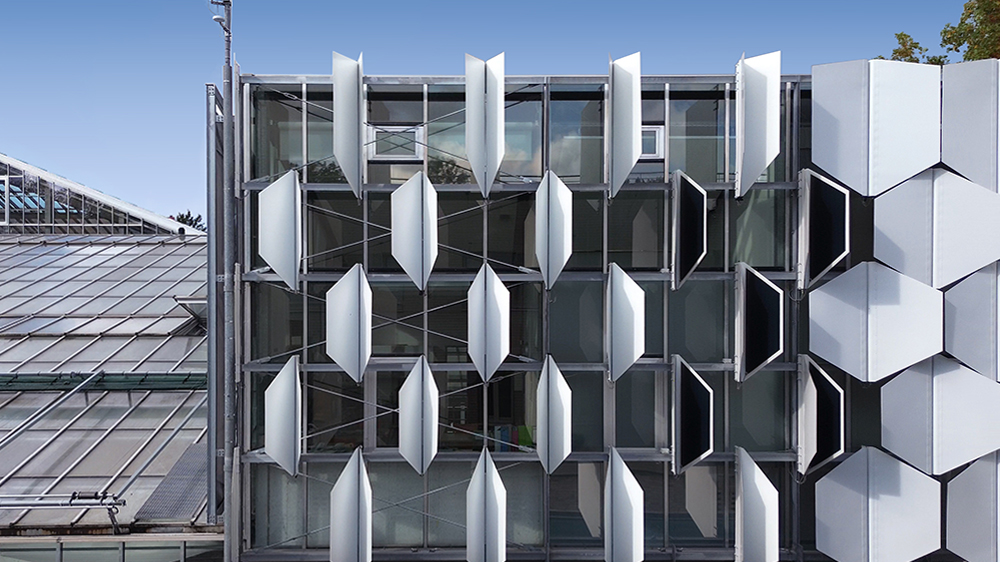
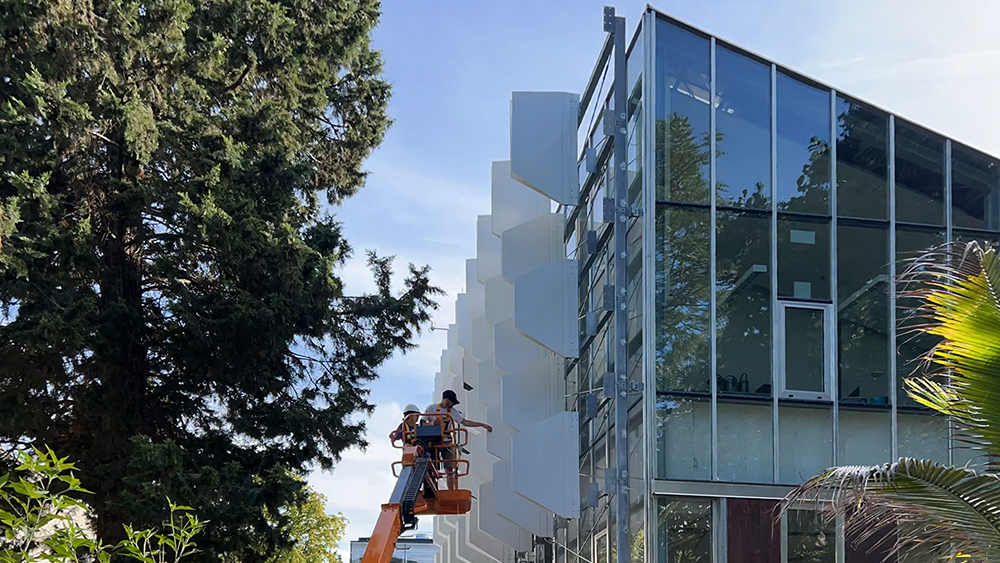
Installed at the Botanical Garden of the University of Freiburg, the project is the first large-scale outdoor demonstrator of responsive fibre-reinforced façade elements, marking acritical step from experimental research to real-world application.
From Mechanics to Material Intelligence
FlectoLine represents a fundamental shift away from traditional façade systems.
Instead of relying on hinges, motors andrigid-body mechanisms, the system is based on compliant mechanisms structures that achieve movement through elastic deformation of materials.
This approach eliminates mechanical complexitywhile introducing a new level of integration between structure, material andmotion.
Each façade module consists of a fiber-reinforced composite plate with embedded pneumatic actuators, capable of bending up to 90° with minimal pressure (0.2–1.5 bar). The motion is not imposed externally it is programmed directly into the material structure.
The result is a façade that behaves less like a machine and more like a biological organism.
Biomimicry as a Design Driver
The project draws directly from biological systems, translating natural principles into architectural performance.
Two key inspirations define the system:
- The waterwheel plant (Aldrovanda vesiculosa), whose movement is driven by internal pressure variations
- The wing structure of insects, where stiffness gradients define deformation behavior
These principles are reinterpreted through layered composite materials, where variations in stiffness control the direction and intensity of bending.
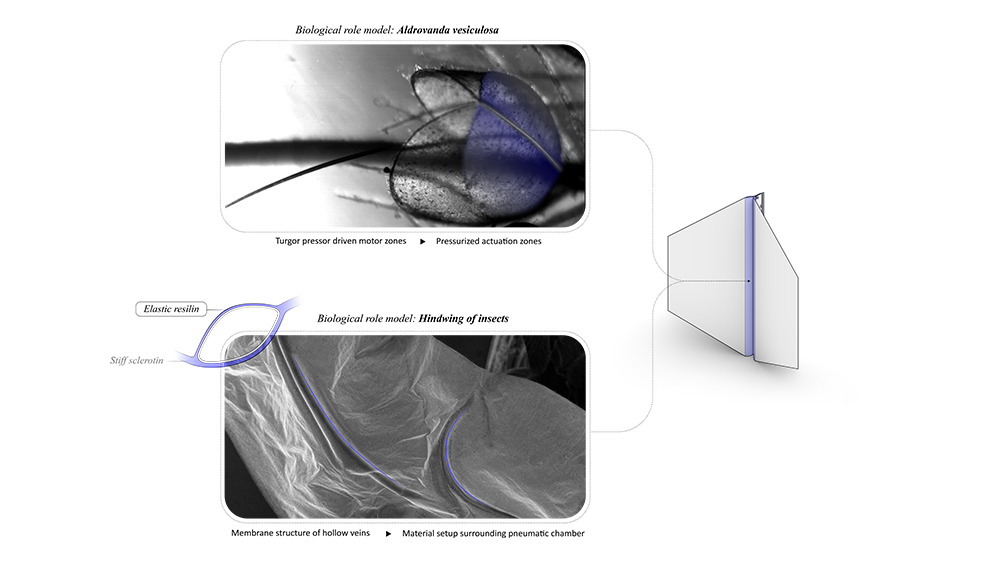
Instead ofadding complexity, the design embeds intelligence into the material itself, reducing the need for mechanical components while increasing reliability and efficiency.
A Fully Integrated Responsive System
FlectoLine is not just a kinetic façade it is a fully integrated responsive system.
Each element is connected to a sensor-driven control network that monitors:
- Solar radiation
- Indoor and outdoor light levels
- Indoor and outdoor temperature
- Wind conditions
This data feeds into a AI, which calculates the performance in real time and predicts optimal configurations.
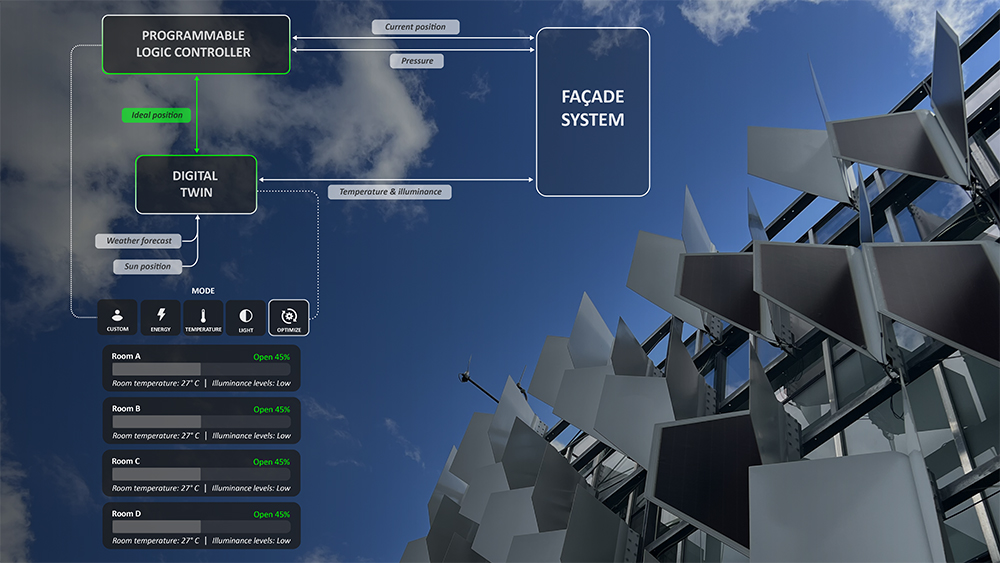
The system continuously adjusts panel orientation to:
- Maximise daylight while reducing glare
- Improve thermal comfort
- Minimise energy consumption
- Optimise photovoltaic energy production
This level of integration positions FlectoLine as a true cyber-physical façade system.
Energy Performance and Photovoltaic Integration
A key innovation lies in the integration of thin-film organic photovoltaic (PV) cells within the responsive elements.
Unlike static BIPV systems, FlectoLine dynamically adjusts the orientation of it spanels to maximise solar exposure throughout the day.
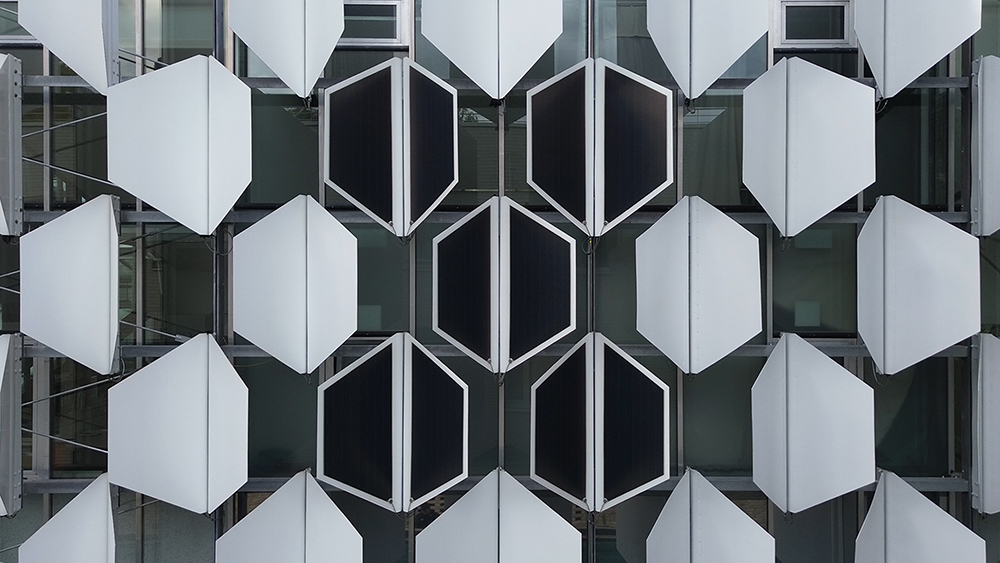
This creates a dual-performance system:
- Adaptive solar shading
- Active energy generation
By combining these functions, the façade contributes both to reducing energy demand and producing renewable energy, moving towards energy-autonomous building envelopes
Material Innovation and Durability
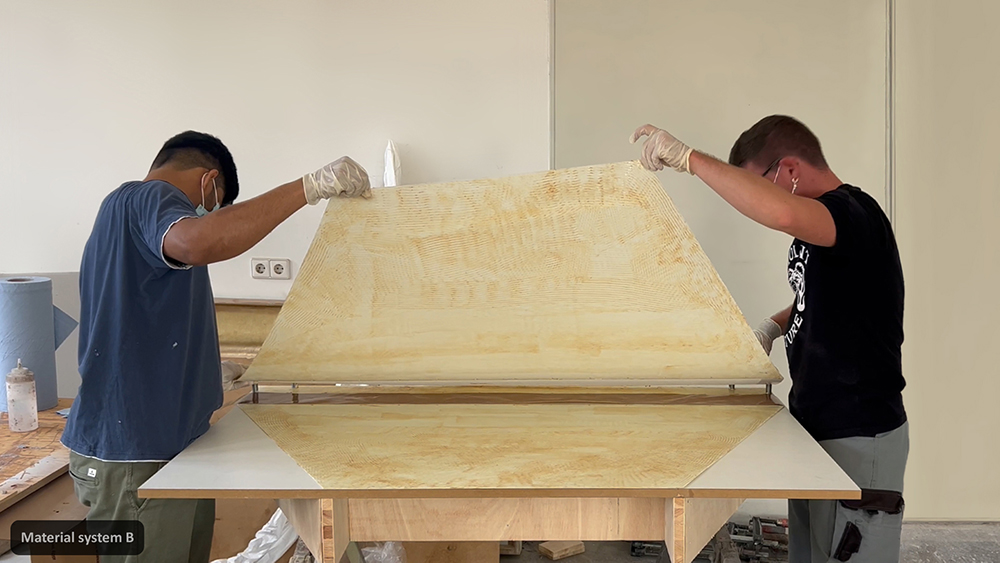
Two material systems were developed to balance performance and scalability
- Thermoset-based fibre-reinforced composites with elastomer layers
- Thermoplastic composite systems (polyamide-based) enabling a more efficient manufacturing
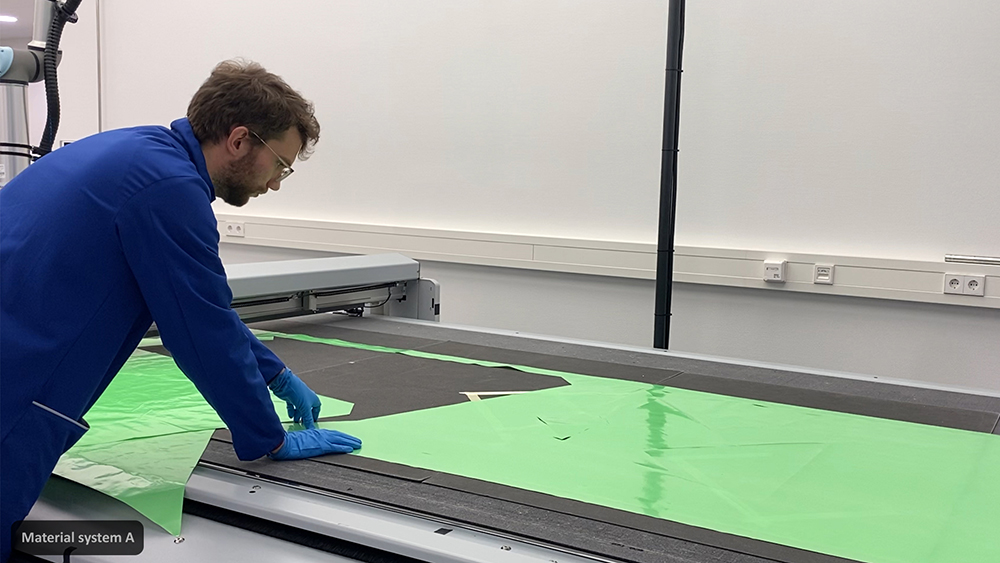
Both systems are engineered to:
- Withstand outdoor conditions for at least 15 years
- Meet fire safety requirements (minimum class B2)
- Resist wind loads and environmental stress
- Perform over 20,000 actuation cycles without degradation
The integration of actuation within the material eliminates mechanical joints, reducing maintenance and increasing long-term reliability.
Scaling Up: A Real-World Demonstrator
FlectoLine moves beyond prototypes into architectural scale.
- Surface area: 83.5 m²
- Number of elements: 101
- Element weight: approx. 3 kg
- Actuation pressure: ~0.4 bar
This makes it the first fully operational outdoor system of its kind, demonstrating that responsive façades can be viable at building scale, not just in laboratory conditions.
Towards a New Façade Paradigm
FlectoLineis more than a research project, it is a glimpse into the future of façade engineering.
It challenges conventional assumptions by showing that:
- Movement can be embedded in materials
- Performance can be adaptive rather than fixed
- Energy systems can be integrated into façade logic
- Buildings can actively interact with their environment
As the industry moves toward decarbonisation and higher performance standards, systems like FlectoLine suggest a new direction, where façades are no longer static elements, but intelligent, responsive interfaces between architecture and climate.
FFF Perspective
FlectoLine doesn’t just introduce a new technology it redefines the role of the façade.
From enclosure to interface.
From system to organism.
And perhaps most importantly:
from passive performance to active behaviour.
Learn More HERE
Events
%201.png)

%201.png)
%201.png)
News


Was your product part of an Urban Icon?
Join the archive that celebrates architecture’s most iconic façades. If your company played a role—through materials, systems, or expertise—let us know. We’re building a record of the people and products behind the world’s most influential buildings.
Further articles

.png)
The Newsletter
Stay close to the future of façades.
Receive curated stories, technical insights, interviews, and event updates from the global façade industry. One edition every Friday.
Oops! Something went wrong while submitting the form.
By subscribing, you agree to our Privacy Policy and consent to receive updates.

An independent editorial platform for façade innovation, material intelligence, and architectural envelope design.
Sections
Platform
Contact
© 2026 Fools for Façades. All rights reserved.
.svg)
.svg)