
0


.jpg)
The Enamel Effect
How Adapta Powder Coatings brought a glossy ceramic effect to the Enterprise Research Campus in Boston
In contemporary façade design, colour is rarely just colour.
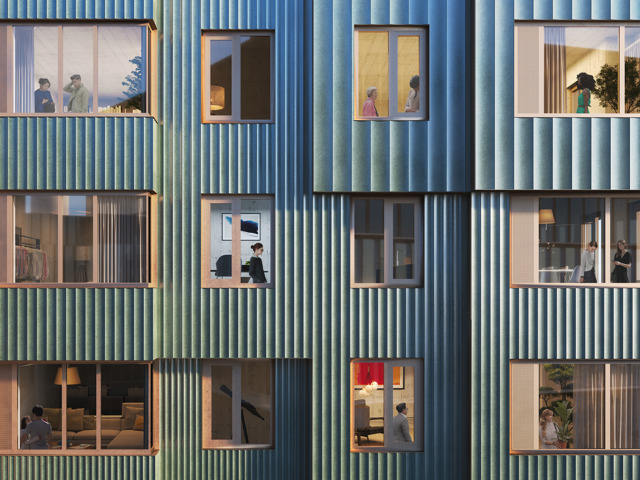
It can connect a building to its urban context, recall local material traditions, define identity, or transform a technical envelope into a more expressive architectural surface. At the Enterprise Research Campus in Allston, Boston, the façade of a new residential building does exactly this: it uses a deep, glossy green aluminium finish to reinterpret one of the city's most recognisable architectural references, the aged copper tones of traditional Boston bay windows. The result is a façade that is at once highly technical and deeply contextual.
Its visual character comes from Adapta Powder Coatings' ENAMEL / Vivendi system, a multi-layer powder coating solution developed to create a ceramic-like, enamelled effect on architectural aluminium while preserving the durability, resistance and sustainability advantages of powder technology.

A new district for research, housing and public life
Located in Boston's Allston neighbourhood, the Enterprise Research Campus is part of a broader urban transformation adjacent to Harvard Business School and Harvard's Science and Engineering Complex. The development is conceived as a mixed-use district combining residential buildings, research and laboratory spaces, hospitality, public open areas, retail, and social infrastructure. Rather than a single isolated project, it forms part of a larger strategy to turn an underused urban area into a more inclusive, walkable and innovation-driven district.
The masterplan, led by Henning Larsen in collaboration with Studio Gang, SCAPE and Utile, aims to create a neighbourhood where research, housing, public life and landscape are integrated into one urban ecosystem. Within this context, the residential buildings play an important role. They are not only housing blocks, but architectural surfaces that help define the identity of the new district.
The Enterprise Research Campus is part of a broader urban transformation adjacent to Harvard Business School and Harvard's Science and Engineering Complex
The residential component includes an 8-storey building and a 17-storey tower, designed by MVRDV.
Together, they contribute to the first phase of the ERC development, which includes apartments, affordable housing units, public spaces, a hotel, research facilities and a conference centre.
The façade strategy reflects this urban ambition: the buildings are clad in glossy green panels that create a textured, changing surface, visually connected to Boston's historic palette while using contemporary materials and technologies.
A Powder Coating with an Enamelled Expression
The façade panels use a three-layer powder coating system from Adapta's ENAMEL Collection, applied to aluminium sheets. The system combines:
- DB-1001 as base coat;
- DB-0142 as the green enamel-effect layer;
- DB-0004 as Eternal clear gloss coat.
The total coating build-up is approximately 300–310 microns, applied on 1 mm aluminium sheet. This multi-layer approach is central to the final appearance of the façade. Rather than producing a flat colour, the system creates depth, reflectivity and a slight visual irregularity, closer to the perception of glazed ceramic or enamelled metal.
This is particularly relevant in façade design because large exterior surfaces are never perceived statically. They change with light, distance, weather, angle and surrounding reflections. A glossy, ceramic-toned finish can therefore give the building a stronger sense of material depth, avoiding the uniformity often associated with standard flat-coated metal panels. In the case of the ERC residential buildings, the green finish was selected to evoke Boston's copper-clad architectural details, especially bay windows whose surfaces naturally age towards green tones over time. The façade does not imitate copper directly, but translates that local reference into a contemporary aluminium envelope.
.jpg)
Durability as a Sustainability Strategy
The project also highlights a key point in façade design: durability is part of sustainability.
When coatings fade, lose gloss, corrode or require early replacement, the impact is not only aesthetic or economic. It also means new materials, new manufacturing cycles, transport, installation, waste and maintenance. A long-lasting coating therefore helps extend the service life of façade components and reduce unnecessary replacement.
Adapta's Vivendi / ENAMEL technology powder is based on super-durable powder coating formulations developed for exterior architectural use. The additional Eternal clear gloss coat improves outdoor resistance, supporting colour stability, gloss retention and long-term façade performance.
For the Boston façade, the system was designed to meet demanding architectural requirements such as AAMA 2605. Accelerated weathering tests showed strong results, with samples exceeding 3,000 hours in Suntest exposure and 2,000 hours in QUV B-313 testing, while maintaining more than 50% of their original gloss.
Fire Classification and Architectural Applications
Beyond appearance and weathering resistance, the system was also tested according to ASTM E84. The ENAMEL system applied on aluminium sheet with DB-1001 + DB-0142 + DB-0004 achieved a Class 1 / Class A classification.
The ENAMEL system applied on aluminium sheet with DB-1001 + DB-0142 + DB-0004 achieved a Class 1 / Class A classification.
The ENAMEL / Vivendi systems are particularly suited for aluminium façade elements such as cassettes, expanded metal panels, perforated panels, sunshades and screens.
In these applications, the coating is not simply a colour layer, but part of the complete architectural expression. At the ERC, the glossy green finish works together with the façade articulation, amplifying the depth, rhythm and changing perception of the building surface.
From Industrial Coating to Architectural Identity
What makes the ERC case interesting is the way an industrial coating technology becomes part of the architectural identity of a place.
Powder coatings are often discussed in terms of performance, compliance and durability. These aspects remain essential. But in projects like this, they also become tools for design language. Adapta's enamel-effect finish allows aluminium to take on a more crafted, ceramic-like presence, closer to traditional architectural materials but with the advantages of modern coating systems.
This hybrid quality is especially relevant for contemporary façades. Architects increasingly seek materials that can perform technically while also carrying cultural, contextual or sensory value. The façade is no longer understood only as a protective layer; it is part of the narrative of the building and of the neighbourhood around it.
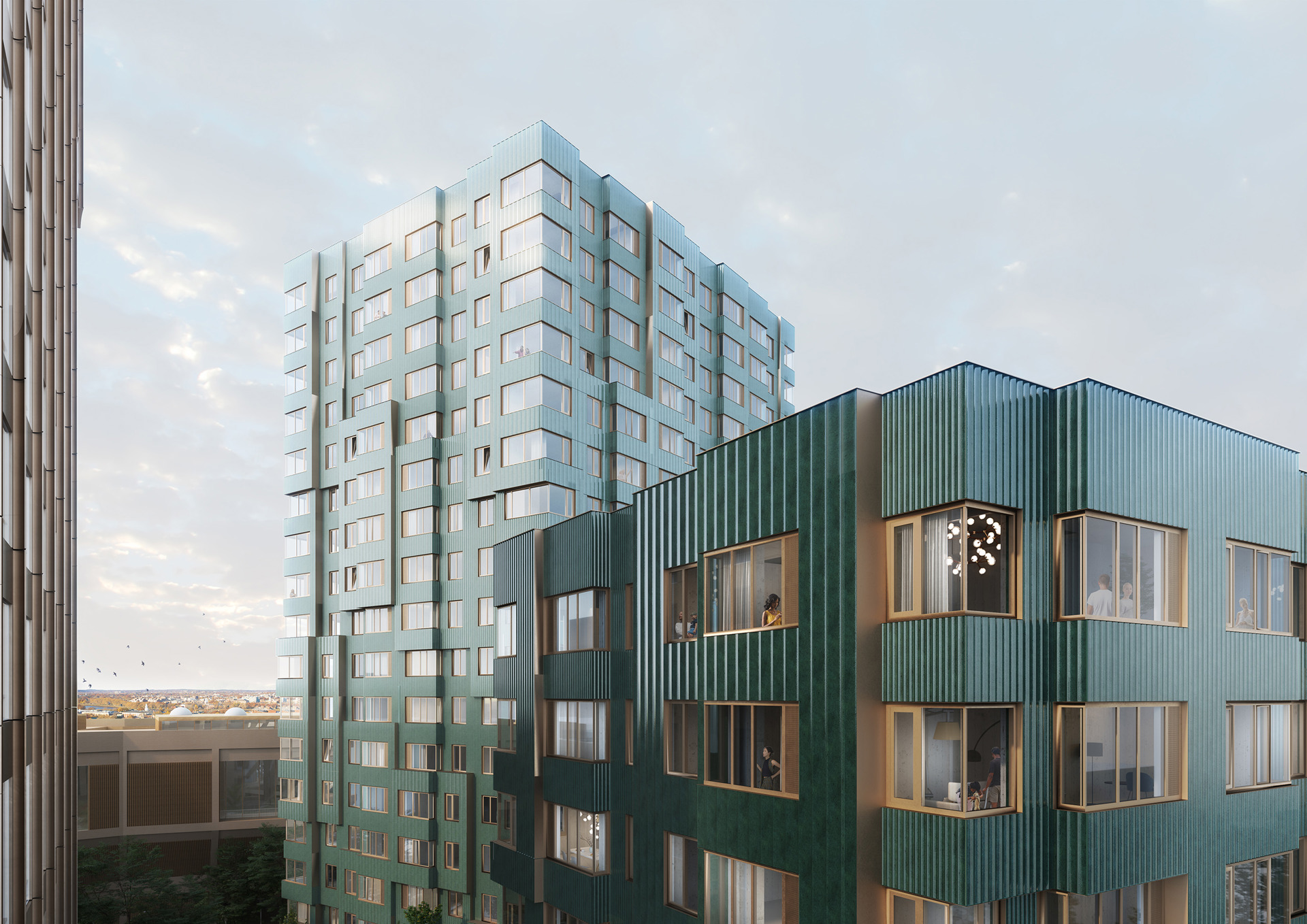
Architects increasingly seek materials that can perform technically while also carrying cultural, contextual or sensory value.
In Boston, the green enamelled surface helps the residential buildings speak to the city's architectural memory without becoming nostalgic. It references the colour of aged copper, but through powder-coated aluminium. It suggests a ceramic depth, but through an industrially controlled façade system. It creates visual richness, but with a coating designed for long-term exterior durability.
A Smart Coating Approach
Adapta Color has built its identity around powder coatings for architecture and design, with a strong focus on innovation, flexibility and technical development. Since its foundation in 1997, the company has positioned itself around the idea that coatings can do more than finish a surface.
Its broader portfolio includes smart coating technologies designed to interact with environmental or operational needs, including antibacterial powder coatings, anti-graffiti systems, anti-corrosion solutions and coatings developed to help reduce atmospheric pollutants.
Within this wider vision, the ENAMEL / Vivendi system occupies a specific position: it shows how powder coatings can expand the aesthetic vocabulary of metal façades while remaining connected to technical performance. It is not only about colour matching, but about creating surfaces with depth, gloss, texture and long-term resistance.
The Enterprise Research Campus demonstrates how façade coatings can support a broader architectural ambition.
The Enterprise Research Campus demonstrates how façade coatings can support a broader architectural ambition. The finish contributes to the character of the building, connects it to local references, supports the sustainability objectives of the project and offers a durable alternative to more maintenance-intensive surface treatments.
Technical Box
Project: Enterprise Research Campus, residential buildings
Location: Allston, Boston, USA
Developer: Tishman Speyer / Harvard-Allston Land Company
Architecture: MVRDV for the residential buildings
Masterplan: Henning Larsen with Studio Gang, SCAPE and Utile
Certification target: LEED Gold
Coating system: Adapta ENAMEL / Vivendi UDS Eternal
Application: Aluminium façade panels
System layers: DB-1001 base coat + DB-0142 enamel-effect green layer + DB-0004 Eternal clear gloss coat
Total coating thickness: approx. 300–310 microns
Substrate: 1 mm aluminium sheet
Fire classification: ASTM E84, Class 1 / Class A
Events
%201.png)

%201.png)
%201.png)
News


Other Posts


Was your product part of an Urban Icon?
Join the archive that celebrates architecture’s most iconic façades. If your company played a role—through materials, systems, or expertise—let us know. We’re building a record of the people and products behind the world’s most influential buildings.
Further articles
The Newsletter
Stay close to the future of façades.
Receive curated stories, technical insights, interviews, and event updates from the global façade industry. One edition every Friday.
Oops! Something went wrong while submitting the form.
By subscribing, you agree to our Privacy Policy and consent to receive updates.

An independent editorial platform for façade innovation, material intelligence, and architectural envelope design.
Sections
Platform
Contact
© 2026 Fools for Façades. All rights reserved.
.svg)
.svg)